On this page
- Introduction
- What Is Custom Software Development?
- 7 Proven Ways Custom Software Can Help a Growing Business
- Build Around Your Actual Business Workflow
- Connect Disconnected Business Systems
- Create Software That Can Evolve With the Business
- Build a Competitive Advantage
- Improve Automation and Operational Efficiency
- Improve Control Over Data and Access
- Reduce Dependence on a Single Vendor
- Custom Software vs. Off-the-Shelf Software
- When Should You Choose Custom Software Development?
- What Experienced Developers Look at Before Writing Code
- Custom Software Development Process
- Discovery
- Product Definition
- Software Architecture
- UX/UI Design
- Development
- Testing
- Deployment
- Maintenance and Improvement
- Why Software Architecture Matters
- API Integration and Custom Software
- Security in Custom Software Development
- How Much Does Custom Software Development Cost?
- How Long Does Custom Software Development Take?
- MVP Development: Start With What Matters
- Common Custom Software Development Mistakes
- Building Too Many Features
- Choosing Technology Before Understanding the Problem
- Overengineering the First Version
- Ignoring Existing Integrations
- Treating Security as a Final Task
- Forgetting Maintenance
- Not Defining Ownership
- Choosing the Right Technology Stack
- How to Choose a Custom Software Development Company
- Custom Software Development Services at Ethereal Softech
- Frequently Asked Questions About Custom Software Development
- What is custom software development?
- When should a business choose custom software?
- Is custom software better than off-the-shelf software?
- How much does custom software development cost?
- How long does custom software development take?
- Can custom software integrate with existing systems?
- Should startups build custom software?
- What happens after software is launched?
- Final Thoughts
Introduction
Custom software development isn’t about building software simply because you can. It’s about creating software around the way your business actually works.
As companies grow, spreadsheets, disconnected SaaS tools, manual processes, and generic applications can start creating operational problems.
Employees may enter the same information into multiple systems. Sales and finance teams may work with different data. Customers may experience delays because an internal process still requires manual approval. A SaaS product may need functionality that an existing platform simply doesn’t support.
Eventually, the business has two choices: change the process to fit the software or build software that fits the process.
That’s where custom software can make sense.
However, custom development isn’t automatically the right answer. If an established SaaS product solves your problem effectively, buying it may be faster, cheaper, and easier to maintain.
The real question is:
When does building custom software create enough business value to justify the investment?
What Is Custom Software Development?
Custom software development is the process of designing, developing, testing, deploying, and maintaining software specifically around a business’s requirements, users, workflows, and objectives.
Unlike off-the-shelf software, a custom application can be designed around the way a particular organization operates.
It can include SaaS platforms, enterprise applications, customer portals, marketplaces, healthcare applications, fintech platforms, internal business systems, mobile applications, web applications, workflow automation platforms, API-based systems, and industry-specific software.
The objective isn’t to create more technology.
The objective is to solve a specific business problem better.
7 Proven Ways Custom Software Can Help a Growing Business
Build Around Your Actual Business Workflow
Every business has processes that are slightly different.
A generic application needs to support a broad range of customers, so its workflows are designed for the average user.
Custom software can be designed around your actual process.
For example, a logistics company may need a specific sequence involving shipment creation, warehouse allocation, driver assignment, delivery confirmation, invoicing, and customer notifications.
Instead of employees moving information between several applications, one system can coordinate the workflow.
The value isn’t simply having a new application.
The value comes from reducing friction in the way the business operates.
Connect Disconnected Business Systems
Modern businesses rarely depend on one application.
A company might use a CRM, ERP, accounting platform, payment gateway, inventory system, customer-support platform, analytics tool, and internal database.
If these systems don’t communicate, employees often become the connection between them.
That’s where API integration becomes important.
A custom application can connect different systems so information moves automatically.
For example:
New order → payment verification → inventory update → fulfillment request → customer notification → CRM update
The exact workflow will differ from business to business, but the principle is simple:
Software should move information wherever possible instead of making employees move it manually.
Create Software That Can Evolve With the Business
A business rarely stays the same for five years.
New customers arrive. New markets open. New integrations become necessary. Pricing models change. Internal teams grow.
Software architecture should therefore consider not only today’s requirements but also reasonable future changes.
That doesn’t mean building every future feature today.
In fact, overengineering can create unnecessary cost.
A better approach is to build a strong foundation while keeping the architecture flexible enough to evolve.
Build a Competitive Advantage
Not every software system needs to be unique.
Accounting, email, project management, and many other standard business functions can often be handled effectively by established products.
But if your software represents a unique business process or is the actual product you’re selling, control becomes much more important.
This is particularly relevant for:
SaaS companies, marketplaces, fintech platforms, healthcare platforms, B2B software products, and specialized business applications.
When software becomes part of the competitive advantage, owning the product roadmap can be valuable.
Improve Automation and Operational Efficiency
Manual work isn’t always bad.
Early-stage businesses often rely on manual processes because they’re inexpensive and flexible.
The problem starts when transaction volume grows.
A process that takes five minutes and happens ten times a day may be manageable.
The same process happening 1,000 times a day becomes an operational problem.
Custom business software can automate repetitive tasks such as:
Data synchronization, notifications, approvals, document processing, reporting, order processing, customer onboarding, inventory updates, and workflow management.
The goal isn’t to automate everything.
The goal is to automate the work where software provides a clear operational benefit.
Improve Control Over Data and Access
Businesses often have information spread across multiple platforms.
That can make it difficult to understand who can access specific information, where data is stored, and how different systems use it.
Custom applications can be designed with specific access rules, roles, workflows, audit requirements, and data structures.
Depending on the application, security considerations may include:
Authentication, authorization, encryption, secure APIs, secrets management, access controls, audit logs, backups, dependency management, monitoring, and vulnerability testing.
Security requirements should be considered during architecture and development—not added as a final checklist before launch.
Reduce Dependence on a Single Vendor
Vendor dependency isn’t always a problem.
Using third-party SaaS products is often the right business decision.
However, companies can become heavily dependent on a vendor’s:
Pricing, feature roadmap, API limitations, data model, usage restrictions, or product availability.
If a critical business process depends entirely on a third-party platform, changes outside your control can affect your operations.
Custom software can provide greater control over critical workflows while still using third-party services where they make business sense.
Custom Software vs. Off-the-Shelf Software
The build vs. buy decision shouldn’t be based solely on development cost.
Consider the total business impact.
| Factor | Off-the-Shelf Software | Custom Software |
|---|---|---|
| Initial investment | Usually lower | Usually higher |
| Launch speed | Usually faster | Usually slower |
| Flexibility | Product-dependent | High |
| Custom workflows | Limited | Designed around requirements |
| Integrations | Depends on APIs | Can be specifically designed |
| Product roadmap | Vendor controlled | Business controlled |
| Differentiation | Usually limited | Potentially significant |
| Maintenance | Mostly vendor managed | Requires ongoing ownership |
For standardized requirements, an existing product is often the better choice.
For unique workflows or software products, custom development can provide greater long-term flexibility.
When Should You Choose Custom Software Development?
A company should seriously consider custom software when several of these conditions apply:
Your workflow is unique, existing software creates significant limitations, multiple systems need to communicate, manual processes are becoming expensive, the software itself is your product, or you need control over the product roadmap.
Another useful question is:
Are we losing more money from the limitations of our current software than we would spend solving the problem?
That doesn’t produce an exact calculation, but it changes the conversation from development cost to business value.
What Experienced Developers Look at Before Writing Code
A strong development team shouldn’t begin by asking which framework to install.
Before writing code, experienced developers should understand:
What data needs to move through the system?
Which integrations are mandatory?
What happens when an external API fails?
Which operations require real-time processing?
What permissions should different users have?
What information needs to be audited?
What happens if traffic increases significantly?
Which components are business-critical?
These questions often matter more than choosing between two popular frameworks.
Technology can change.
A poorly considered architecture can be much more expensive to change.
Custom Software Development Process
A professional software project typically moves through several stages.
Discovery
The team studies the business model, users, workflows, pain points, integrations, constraints, and objectives.
Product Definition
Requirements are converted into a practical product scope.
This is where unnecessary features should be challenged.
Software Architecture
The technical team defines the application’s data model, APIs, authentication, integrations, infrastructure, security, and expected growth requirements.
UX/UI Design
User journeys are converted into practical interfaces.
Good design isn’t only about appearance.
It should reduce confusion and make important actions easy to complete.
Development
The application is built in manageable iterations.
This allows problems to be discovered before the entire product has been completed.
Testing
Depending on the application, testing may include functional, integration, performance, security, and user acceptance testing.
Deployment
The application is deployed to its production environment and configured for monitoring and operational use.
Maintenance and Improvement
Software requires ongoing maintenance after launch.
That can include:
Security updates, dependency updates, bug fixes, monitoring, performance optimization, infrastructure management, and new feature development.
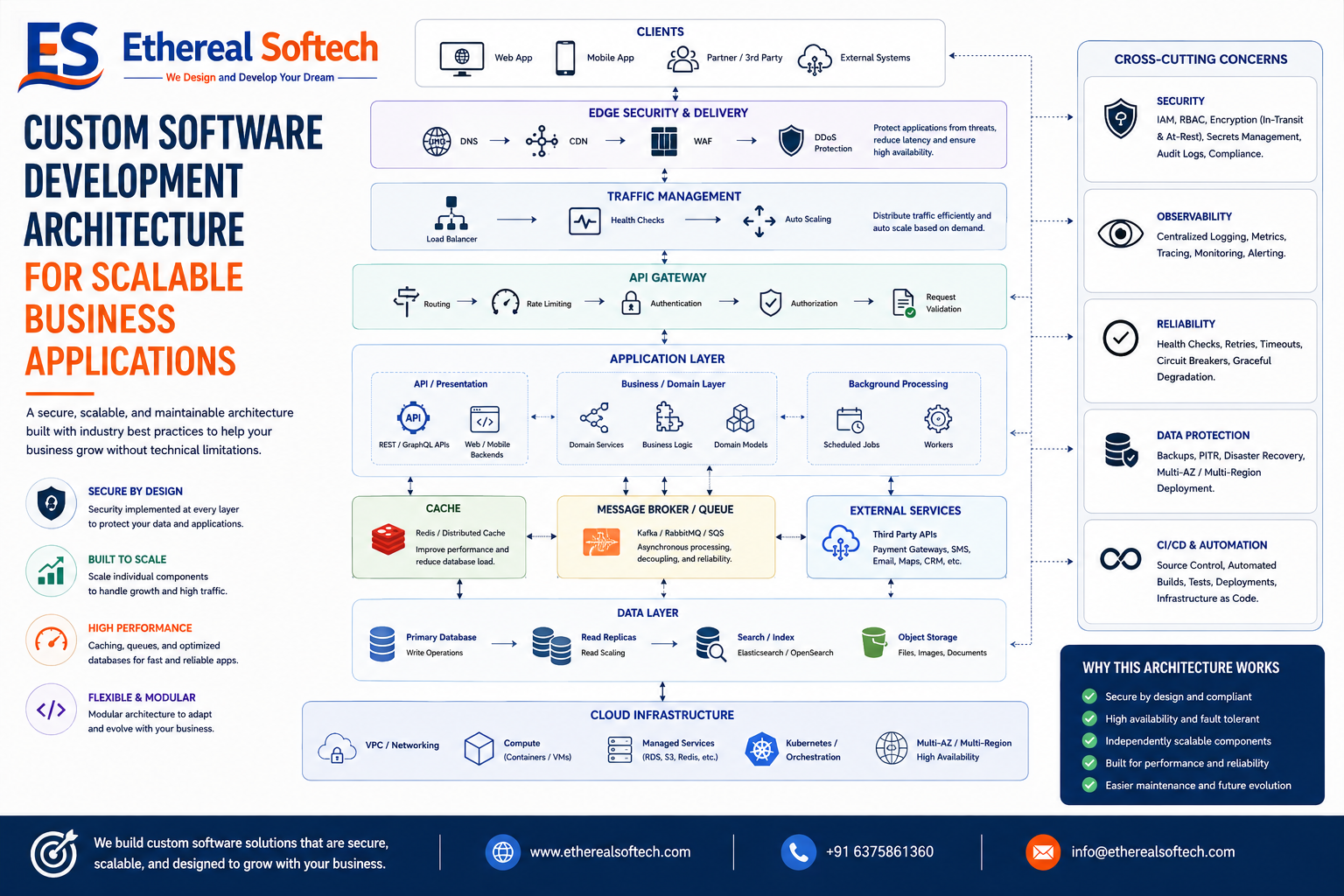
Why Software Architecture Matters
A system designed for a small internal team doesn’t necessarily need the same architecture as a public SaaS platform.
Good architecture should reflect actual requirements.
A modern application may need:
Authentication, authorization, databases, APIs, background jobs, file storage, caching, queues, logging, monitoring, third-party integrations, backups, and cloud infrastructure.
But adding more technologies doesn’t automatically make a system better.
A smaller product may not need microservices or a highly distributed architecture.
In many situations, a well-designed modular application is easier to build, test, operate, and maintain.
The best architecture is usually the simplest architecture that can reasonably support the product’s requirements and expected growth.
API Integration and Custom Software
Integration is one of the most practical reasons to consider custom development.
A business may already have valuable systems in place.
Replacing everything isn’t always necessary.
Instead, a custom application can connect existing systems through APIs.
For example:
CRM → Custom Application → Payment Gateway → ERP → Analytics
This approach can allow the company to retain useful existing systems while creating a central workflow around them.
That can be considerably more practical than replacing every application.
Security in Custom Software Development
Security should be part of the development process from the beginning.
The appropriate security controls depend on the application and the type of data being handled.
A project may need:
Authentication, authorization, encryption, secure API design, access control, audit logging, secrets management, vulnerability testing, backups, monitoring, and secure dependency management.
For web applications, the OWASP Top 10 is a useful industry reference for understanding common application security risks.
Security isn’t a feature that can simply be switched on before launch.
It needs to influence architecture, development, testing, deployment, and ongoing maintenance.
How Much Does Custom Software Development Cost?
There is no single price for custom software.
A small internal application and a multi-tenant SaaS platform have completely different engineering requirements.
The total cost can depend on:
Features, number of platforms, integrations, user roles, UX/UI complexity, security requirements, infrastructure, third-party services, testing, development team size, and maintenance requirements.
The best way to control cost isn’t necessarily to hire the cheapest developer.
It’s to control unnecessary scope.
A focused MVP can help a company validate important assumptions before investing heavily in advanced functionality.
How Long Does Custom Software Development Take?
Development timelines depend on the product.
A focused MVP can potentially take several weeks to a few months, while complex enterprise, SaaS, healthcare, or fintech platforms can require significantly longer development cycles.
A typical project includes:
Discovery → Product Definition → Architecture → Design → Development → Testing → Deployment → Iteration
Avoid relying on an exact timeline before the requirements have been properly understood.
A credible estimate should explain what affects the schedule.
MVP Development: Start With What Matters
An MVP doesn’t mean building low-quality software.
It means building the smallest useful product capable of testing important business assumptions.
Imagine you’re developing an appointment platform.
The first version might need:
User registration, provider profiles, availability, appointment booking, notifications, and administration.
Advanced analytics, loyalty programs, complex automation, and dozens of integrations may not be necessary initially.
Build the core experience.
Get it in front of users.
Learn from actual usage.
Then invest in the features that demonstrate real value.
Common Custom Software Development Mistakes
Building Too Many Features
Every feature adds development, testing, maintenance, and support requirements.
Choosing Technology Before Understanding the Problem
A popular framework isn’t automatically the right framework.
Overengineering the First Version
Don’t introduce unnecessary infrastructure simply because it is fashionable.
Ignoring Existing Integrations
A new application should fit into the wider technology environment.
Treating Security as a Final Task
Security decisions made late can become expensive architectural problems.
Forgetting Maintenance
Software is a long-term product, not a one-time deliverable.
Not Defining Ownership
Before development begins, clarify ownership of:
Source code, infrastructure, cloud accounts, domains, databases, documentation, third-party accounts, and intellectual property.
Choosing the Right Technology Stack
There is no universal technology stack for every project.
The technology should follow the requirements.
Python/FastAPI can be useful for API-driven applications, data-intensive systems, and AI integrations.
Node.js can work well for APIs, real-time applications, and JavaScript/TypeScript-focused teams.
Laravel can be productive for many business applications.
Flutter and React Native can help teams build cross-platform mobile applications.
Kotlin and Swift are appropriate when native Android or iOS capabilities are important.
AWS, Azure, and Google Cloud provide different infrastructure and managed services for application deployment and scaling.
The right choice balances:
Product requirements, engineering expertise, performance, security, development speed, infrastructure cost, and long-term maintenance.
How to Choose a Custom Software Development Company
Don’t evaluate a software development company only by its hourly rate.
Look at how the team approaches the problem.
Ask:
Can they understand the business requirement?
Can they explain the architecture clearly?
Will they challenge unnecessary features?
How will they approach security?
How will the software be tested?
Who owns the source code?
What happens after launch?
Can they support future development?
A good development partner shouldn’t agree with every requirement simply to win the project.
Sometimes the most valuable answer is:
“You don’t need to build that yet.”
That decision can save significant development time and cost.
Custom Software Development Services at Ethereal Softech
At Ethereal Softech, we approach software projects from the business problem first.
Our custom software development services cover web applications, mobile applications, SaaS platforms, enterprise software, API integrations, cloud applications, AI-powered products, e-commerce solutions, and industry-specific platforms.
Depending on the requirements, our teams work with technologies including Python/FastAPI, Node.js, Laravel, Flutter, React Native, Kotlin, AWS, Shopify, and modern AI technologies.
The technology isn’t the starting point.
The problem is.
We first look at:
What needs to be solved? Who will use the product? Which systems need to communicate? What should the first version achieve? What could change as the business grows?
Those answers influence the product scope, architecture, technology choices, and development approach.
The goal isn’t to make a project unnecessarily complicated.
It’s to build software that solves the right problem today while giving the product room to evolve tomorrow.
Frequently Asked Questions About Custom Software Development
What is custom software development?
Custom software development is the process of building software specifically around a company’s requirements, workflows, users, and business objectives instead of relying entirely on an off-the-shelf product.
When should a business choose custom software?
A business should consider custom software when its workflow is strategically important, existing products cannot meet critical requirements, multiple integrations are needed, or the software itself creates competitive differentiation.
Is custom software better than off-the-shelf software?
Not necessarily. Off-the-shelf software is often better for standardized business requirements. Custom development becomes more valuable when flexibility, control, integrations, or unique workflows are important.
How much does custom software development cost?
There is no fixed cost. Features, complexity, platforms, integrations, security requirements, infrastructure, team size, and ongoing maintenance all influence the investment.
How long does custom software development take?
A focused MVP can take several weeks to a few months, while complex SaaS, enterprise, healthcare, or fintech platforms can require considerably longer.
Can custom software integrate with existing systems?
Yes. Custom applications can connect with CRM, ERP, accounting, payment, inventory, analytics, communication, and other systems through APIs and integration services.
Should startups build custom software?
Startups should consider custom development when software is central to their product, workflow, or competitive advantage, or when existing solutions cannot adequately support their business model.
What happens after software is launched?
Production software needs ongoing monitoring, security updates, bug fixes, dependency updates, infrastructure management, performance optimization, and future development.
Final Thoughts
Custom software development isn’t about building something simply because you can.
It’s about owning the technology that genuinely matters to your business.
If an existing product solves your problem well, use it.
If your employees are constantly working around software limitations, your systems don’t communicate, or your software is the product you’re selling, custom development may be worth the investment.
Start with the business problem.
Define the smallest useful solution.
Choose technology based on actual requirements.
Build, measure, learn, and improve.
Build software around your business—not the other way around.
If you’re planning a new software product, replacing an outdated system, or connecting disconnected business processes, Ethereal Softech can help you evaluate the requirement before you commit to the technology.
Explore Ethereal Softech: https://etherealsoftech.com