On this page
- What Is an Offshore Development Center?
- How Does an Offshore Development Center Work?
- Why Are Companies Choosing Offshore Development Centers?
- 7 Key Benefits of an Offshore Development Center
- Access to a Larger Technology Talent Pool
- Build a Dedicated Team Instead of Buying Individual Hours
- Scale Engineering Capacity
- Improve Cost Control
- Extend Development Coverage Across Time Zones
- Bring Specialized Skills Into the Team
- Focus the Internal Team on Core Business
- Offshore Development Center vs Traditional Outsourcing
- Offshore Development Center vs Dedicated Development Team
- What Does an Offshore Development Center Cost?
- What Roles Should an Offshore Development Center Have?
- How to Choose the Right Offshore Development Company
- Common Offshore Development Center Mistakes
- How to Build a Successful Offshore Development Center
- Stage 1: Define the Business Objective
- Stage 2: Design the Team
- Stage 3: Establish Engineering Standards
- Stage 4: Establish Communication
- Stage 5: Measure Outcomes
- When Should You Consider an Offshore Development Center?
- When an Offshore Development Center May Not Be the Right Choice
- Why India Is Considered for Offshore Development
- Frequently Asked Questions
- What is an Offshore Development Center?
- Is an Offshore Development Center the same as outsourcing?
- What are the main benefits of an Offshore Development Center?
- How much does an Offshore Development Center cost?
- Is India good for an Offshore Development Center?
- How long does it take to build an Offshore Development Center?
- How do I choose an Offshore Development Center partner?
- Can startups use an Offshore Development Center?
- Build the Team Around the Product, Not the Other Way Around
Hiring software developers locally is not always the hardest part of building a technology team.
The harder problem is building the right team at the right time, keeping engineering quality consistent, managing costs, and having enough technical capacity to keep the product moving.
That is where an Offshore Development Center (ODC) can make sense.
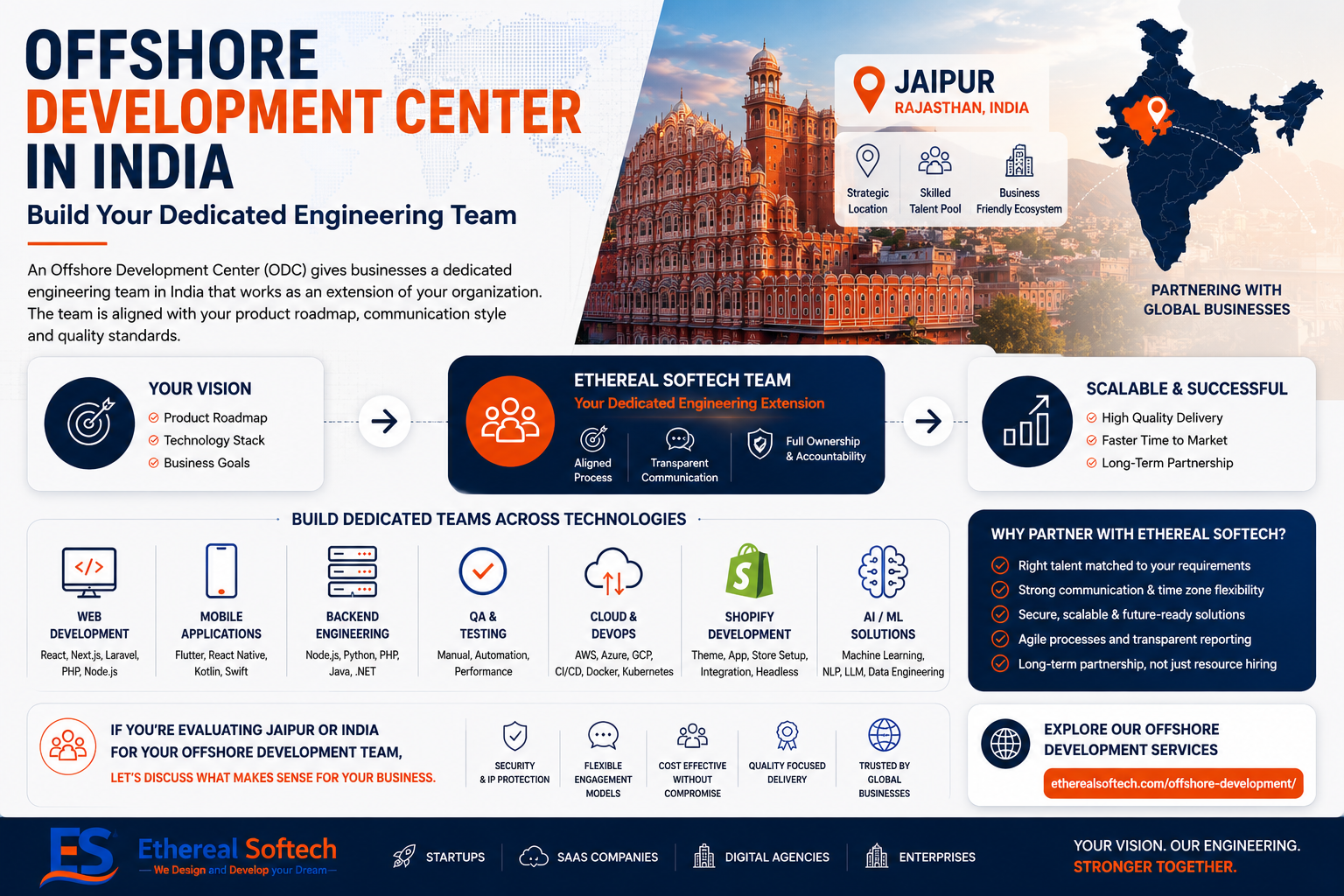
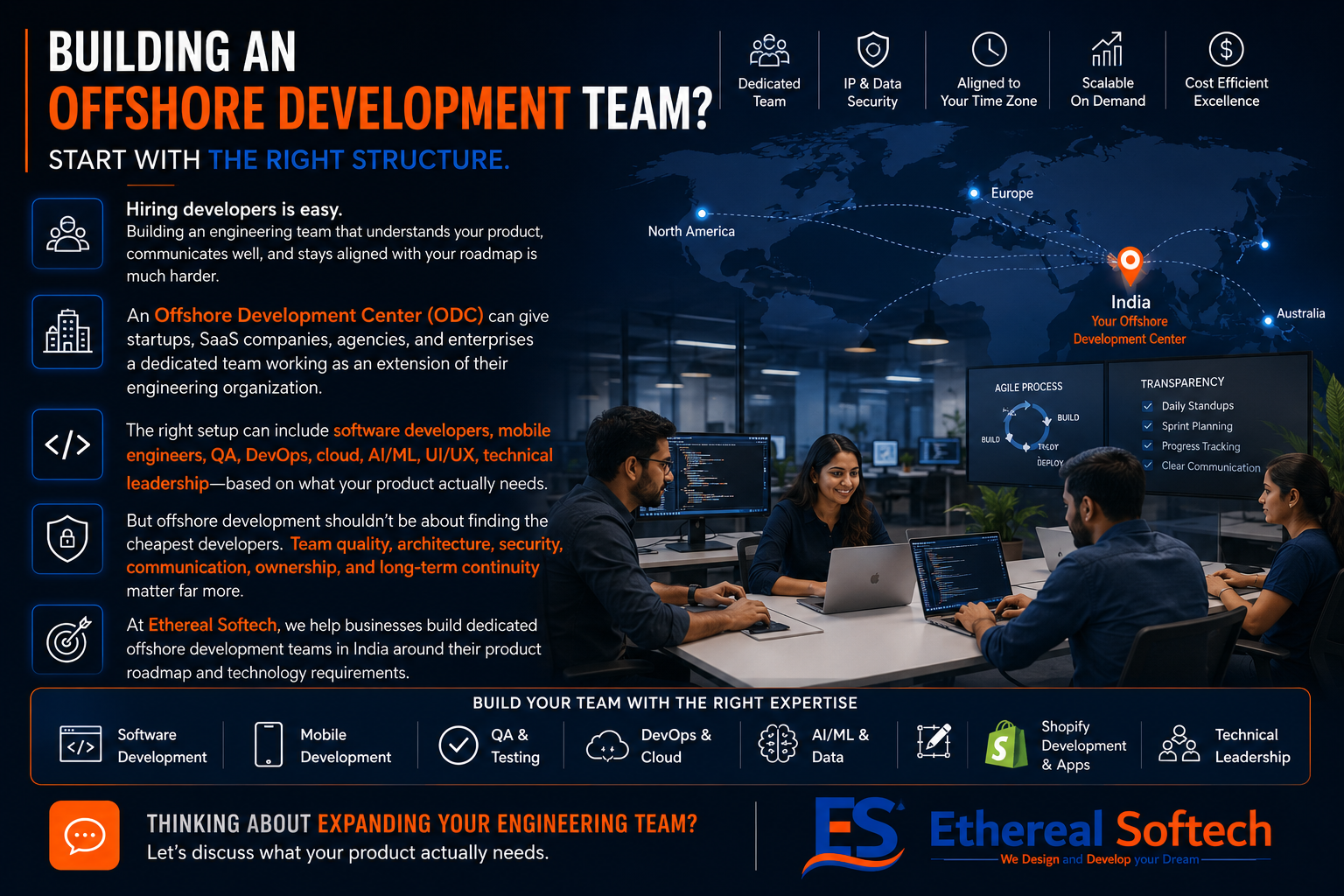
An Offshore Development Center is a dedicated software development team located in another country and working as an extension of your internal organization. Depending on the engagement, the team can include software engineers, QA engineers, UI/UX designers, DevOps engineers, project managers, business analysts, and other specialists.
The important point is that an ODC is not simply about outsourcing a few development tasks.
A well-designed ODC becomes an extended engineering capability that works within your product roadmap, development process, security requirements, communication practices, and delivery goals.
For startups, SaaS companies, digital businesses, and enterprises, this model can provide access to engineering talent without requiring the company to build every part of the team locally.
What Is an Offshore Development Center?
An Offshore Development Center is a dedicated technology team established in a different country to support a company’s software development operations.
Instead of hiring one developer for one project, the business can build a team around its actual engineering requirements.
For example, an ODC for a SaaS company might include a tech lead, backend developers, frontend developers, mobile developers, QA engineers, and DevOps support.
The team can work on the company’s existing product, a new application, modernization project, cloud infrastructure, or long-term product roadmap.
The exact operating model varies.
Some companies manage the offshore team directly. Others use a technology partner to recruit, manage, coordinate, and support the team.
The best model depends on how much control, management responsibility, and operational support the company wants.
How Does an Offshore Development Center Work?
A typical ODC starts with understanding the business and technical requirements rather than immediately hiring developers.
The process usually looks like this:
Business requirements → technical assessment → team design → hiring/onboarding → development process → delivery → monitoring and scaling
The first step is defining what the team needs to accomplish.
For example, a company might need to build a mobile application, develop a SaaS platform, migrate a legacy application, implement cloud infrastructure, or add engineering capacity to an existing product team.
The next step is deciding the required roles and technology stack.
A product may require React and Node.js developers, while another may require Flutter, Python, FastAPI, AWS, DevOps, QA automation, or AI/ML expertise.
Once the team is established, engineering processes become important.
The offshore team should have access to the required repositories, documentation, project management tools, environments, communication channels, coding standards, and security policies.
That is what separates a functioning development center from simply hiring remote freelancers.
Why Are Companies Choosing Offshore Development Centers?
The reason is changing.
Offshore development was once discussed primarily around labor-cost differences.
Today, the conversation is broader.
Companies are looking for engineering capacity, specialized skills, scalability, faster hiring, product continuity, and access to global technology talent.
India is a particularly significant technology delivery market. Its offshore technology ecosystem has expanded into higher-value software engineering, R&D, product development, and other strategic technology functions. Reuters reported that India’s Global Capability Centres were projected to generate $98.4 billion in FY2026, with more than 2,100 GCCs operating in the country.
An ODC should not be confused with a GCC, however. A GCC is typically a captive operation owned or controlled by the parent organization, while an ODC can be established and operated through an external technology partner.
7 Key Benefits of an Offshore Development Center
Access to a Larger Technology Talent Pool
A company hiring only within one city or country is naturally limited by the available talent.
An offshore model expands that search.
Businesses can access developers and specialists across software engineering, mobile development, cloud computing, DevOps, QA automation, data engineering, AI/ML, cybersecurity, and other areas.
This becomes particularly useful when a company needs a skill that is difficult or expensive to hire locally.
Build a Dedicated Team Instead of Buying Individual Hours
One of the biggest advantages of an ODC is continuity.
A dedicated team can understand the product architecture, business logic, coding standards, customer requirements, and long-term roadmap.
That knowledge compounds over time.
You are not starting from zero every time a new development task arrives.
Scale Engineering Capacity
Product requirements change.
A startup may initially need three developers and one QA engineer.
Six months later, it may need backend engineers, mobile developers, DevOps support, and additional QA capacity.
An ODC can provide a structured way to scale the team as the product evolves.
The goal is not simply to add more people.
It is to add the right capabilities at the right stage.
Improve Cost Control
Cost can be an important reason for considering offshore development, but it should not be the only reason.
A lower hourly rate does not automatically mean a lower total cost.
Poor architecture, weak communication, high developer turnover, rework, delayed releases, and inadequate testing can quickly eliminate any initial savings.
A better way to evaluate an ODC is through total delivery economics.
Consider engineering cost, management overhead, recruitment effort, infrastructure, retention, productivity, quality, and time to delivery.
That provides a much more realistic comparison than hourly rates alone.
Extend Development Coverage Across Time Zones
Time-zone differences can be useful when managed properly.
For example, an offshore team can continue development, testing, documentation, or deployment preparation while the primary team is offline.
But this only works when communication is structured.
A time-zone difference without clear documentation and handover processes can create more problems than benefits.
The goal should be asynchronous productivity with sufficient overlapping working hours, not simply “24/7 development.”
Bring Specialized Skills Into the Team
Not every company needs every technology specialist permanently.
An ODC can provide access to specialized expertise when required.
That might include cloud architecture, DevOps, cybersecurity, performance engineering, QA automation, AI/ML, data engineering, or mobile development.
This is especially useful for startups that need senior technical capabilities without immediately building a large permanent organization.
Focus the Internal Team on Core Business
Your internal team does not have to handle every engineering responsibility.
A well-managed offshore team can take responsibility for defined engineering areas while internal leadership focuses on product strategy, customers, sales, partnerships, fundraising, or market expansion.
The key is clear ownership.
An offshore team should not become a black box.
Offshore Development Center vs Traditional Outsourcing
These models are often used interchangeably, but they can operate differently.
| Factor | Offshore Development Center | Traditional Project Outsourcing |
|---|---|---|
| Team structure | Dedicated team | Project-based team |
| Long-term engagement | Usually stronger | Depends on project |
| Product knowledge | Builds over time | May reset between projects |
| Team scalability | Relatively flexible | Usually tied to project scope |
| Client involvement | Often higher | Can be lower |
| Product ownership | Client-led | Vendor may manage delivery |
| Best suited for | Long-term engineering | Defined projects |
Neither model is automatically better.
If you need a clearly defined application with a fixed scope, traditional outsourcing may be appropriate.
If you are continuously building and evolving a product, a dedicated offshore development model may be a better fit.
Offshore Development Center vs Dedicated Development Team
There is also an important distinction here.
A dedicated development team generally describes the staffing arrangement.
An Offshore Development Center can be broader.
An ODC may include the team itself plus operational processes, infrastructure, project management, recruitment, security practices, technical leadership, and ongoing team scaling.
Think of a dedicated team as the people.
Think of an ODC as the engineering capability around those people.
What Does an Offshore Development Center Cost?
There is no single ODC price.
The cost depends on several variables:
Team size, developer seniority, technology stack, project complexity, management model, security requirements, infrastructure, working hours, and engagement duration.
For example, a small product team consisting of a tech lead, two developers, and a QA engineer will have a very different cost structure from an enterprise engineering organization with multiple development squads, DevOps, security, QA automation, and project management.
Instead of asking:
“How much does an offshore developer cost?”
A better question is:
“What engineering capability do we need, and what will it cost to operate that capability reliably?”
That shift leads to better technology decisions.
What Roles Should an Offshore Development Center Have?
There is no universal team structure.
A typical software product team may include:
Technical Lead, responsible for architecture and technical decisions.
Frontend Developers, responsible for web application interfaces.
Backend Developers, responsible for APIs, business logic, databases, and integrations.
Mobile Developers, responsible for Android, iOS, Flutter, or React Native applications.
QA Engineers, responsible for functional, regression, automation, and performance testing.
DevOps Engineers, responsible for CI/CD, cloud infrastructure, deployment, monitoring, and reliability.
UI/UX Designers, responsible for product experience and interface design.
Project/Product Managers, responsible for planning, coordination, priorities, and delivery.
The exact structure should be designed around the product rather than filling a predefined list of positions.
How to Choose the Right Offshore Development Company
Choosing the cheapest vendor is usually the wrong starting point.
Instead, evaluate the company across several areas.
Technical capability
Can the team work with your existing technology stack?
Can they understand your architecture instead of forcing a new stack?
Engineering quality
Ask about code review, testing, CI/CD, documentation, monitoring, and deployment practices.
Communication
Determine how meetings, documentation, escalation, status reporting, and asynchronous communication will work.
Security
Understand how source code, credentials, customer data, infrastructure, and access permissions are protected.
For organizations handling personal data, security and compliance requirements should be reviewed before onboarding the team. India’s Digital Personal Data Protection Act, 2023 establishes a legal framework concerning the processing of digital personal data, making data governance an important consideration for organizations operating with Indian teams and infrastructure.
Team continuity
Ask how the provider handles developer turnover.
A company should have a process for knowledge transfer and replacement without putting the product at risk.
Transparency
You should understand what you are paying for, who is working on the product, how delivery is measured, and who owns the resulting work.
Common Offshore Development Center Mistakes
An ODC can work extremely well, but only when the operating model is designed properly.
The most common mistake is treating offshore development as a simple cost-cutting exercise.
Another mistake is hiring developers before defining the product architecture and responsibilities.
Other problems include unclear ownership, poor documentation, weak security controls, unrealistic timelines, insufficient testing, too many communication channels, and no process for handling developer turnover.
The solution is not more meetings.
It is better engineering governance.
Define responsibilities early. Document important decisions. Establish coding standards. Use version control correctly. Automate testing where appropriate. Monitor production systems. Review architecture regularly.
Good engineering discipline matters regardless of where the team is located.
How to Build a Successful Offshore Development Center
A strong ODC generally follows five stages.
Stage 1: Define the Business Objective
Start with the outcome.
Are you trying to accelerate product development, reduce recruitment pressure, modernize legacy software, expand engineering capacity, or build a new product?
Without a clear objective, team expansion can become expensive headcount growth without meaningful progress.
Stage 2: Design the Team
Map the required capabilities to actual product requirements.
Do not hire ten developers simply because ten developers are available.
Build the smallest team capable of delivering the next meaningful stage of the product.
Stage 3: Establish Engineering Standards
Set expectations for code quality, testing, documentation, security, branching strategy, deployment, monitoring, and incident management.
These standards should be agreed before development becomes large and difficult to control.
Stage 4: Establish Communication
Create a predictable rhythm.
Weekly planning, daily asynchronous updates, technical reviews, sprint demos, documentation, and clearly defined escalation paths can work better than filling calendars with meetings.
Stage 5: Measure Outcomes
Measure more than lines of code or hours worked.
Track meaningful indicators such as release frequency, defect rates, lead time, delivery predictability, system reliability, test coverage where appropriate, and product outcomes.
When Should You Consider an Offshore Development Center?
An ODC may be worth considering when:
Your product roadmap is growing faster than your local engineering team.
You cannot hire specialized developers quickly enough.
You need a dedicated engineering team for long-term product development.
You want to expand development capacity without building every operational function internally.
You are modernizing legacy applications.
You need additional web, mobile, cloud, DevOps, QA, or AI/ML engineering capabilities.
You want an engineering partner that can scale with your product.
When an Offshore Development Center May Not Be the Right Choice
An ODC is not automatically the best model.
For a very small, short-term project with a clearly defined scope, traditional project outsourcing may be simpler.
If your organization cannot provide product ownership, technical direction, timely feedback, or access to required systems, an offshore team may struggle.
Likewise, if the project requires constant real-time collaboration and there is little overlap between working hours, a nearshore model may be worth evaluating.
The right model depends on the work, team, communication requirements, security needs, and business goals.
Why India Is Considered for Offshore Development
India has developed a large technology ecosystem covering software engineering, product development, cloud, mobile applications, data, AI, cybersecurity, and enterprise technology.
The country’s technology ecosystem is also moving beyond the traditional outsourcing model. India’s GCC market increasingly includes product engineering, R&D, and strategic technology functions rather than only back-office work.
For companies considering an offshore development center in India, the important question should therefore not simply be:
“Can India provide cheaper developers?”
It should be:
“Can we build a reliable engineering capability in India that integrates with our business?”
That is a much better question.
Frequently Asked Questions
What is an Offshore Development Center?
An Offshore Development Center is a dedicated software engineering team located in another country and working as an extension of a company’s internal technology organization.
Is an Offshore Development Center the same as outsourcing?
Not necessarily. Traditional outsourcing is often project-based, while an ODC is generally designed around a dedicated, longer-term engineering capability.
What are the main benefits of an Offshore Development Center?
The major benefits can include access to a broader talent pool, scalable engineering capacity, specialized technical skills, cost control, development continuity, and the ability to extend an internal engineering organization.
How much does an Offshore Development Center cost?
There is no fixed price. Cost depends on team size, roles, experience, technology requirements, management, security, infrastructure, and engagement duration.
Is India good for an Offshore Development Center?
India has a large and mature technology ecosystem with capabilities across software development, cloud, mobile, AI, data, DevOps, QA, and enterprise engineering. The quality of an ODC still depends heavily on the selected partner, team structure, governance, and engineering practices.
How long does it take to build an Offshore Development Center?
The timeline depends on the required team and operating model. A small team can be established relatively quickly, while a larger engineering center involving multiple roles, security requirements, infrastructure, and processes requires more planning.
How do I choose an Offshore Development Center partner?
Evaluate technical expertise, previous delivery experience, communication, security, team continuity, development practices, transparency, ownership terms, and the ability to scale the team.
Can startups use an Offshore Development Center?
Yes. Startups can use an ODC when they need dedicated engineering capacity but do not want to build every development role internally from the beginning.
Build the Team Around the Product, Not the Other Way Around
An Offshore Development Center should not be viewed as a shortcut to cheaper software development.
The better way to think about it is as an extension of your engineering organization.
The right team can help a startup move faster, help an established company increase engineering capacity, and help enterprises build specialized technology capabilities.
But the location of the team is only one part of the equation.
Architecture, communication, engineering quality, security, product ownership, technical leadership, and accountability ultimately determine whether the model works.
At Ethereal Softech, we help businesses evaluate the right development model before assembling the team. Depending on the product, that can include web development, mobile app development, SaaS engineering, AI/ML, cloud development, QA automation, DevOps, and dedicated development teams.
If you’re considering building an offshore development team in India, let’s first understand your product, current team, technology stack, and roadmap — then determine what team structure actually makes sense.
Build the engineering capability your product needs, not simply a bigger team.