
On this page
- Quick Answer: Is Jaipur Good for an Offshore Development Center?
- What Is an Offshore Development Center?
- Why Do Global Companies Choose Offshore Development in India?
- Why Consider Jaipur?
- An Established IT/ITeS Ecosystem
- A Growing Engineering Talent Market
- Jaipur Gives You Another Option Beyond the Largest Tech Hubs
- Infrastructure Matters More Than a City Name
- Don’t Compare ODCs Only by Developer Salary
- Jaipur’s Technology Ecosystem Is Also Evolving
- What Should a Jaipur ODC Look Like?
- ODC vs Agency vs Remote Development Team
- Security Should Be Part of the ODC Architecture
- Who Owns the Source Code?
- How Do You Manage an ODC Across Time Zones?
- A Practical 90-Day ODC Setup
- Days 1–30: Define the Foundation
- Days 31–60: Establish the Engineering System
- Days 61–90: Move Toward Independent Delivery
- How Should You Measure an ODC?
- When Does Jaipur Make Sense?
- When Might Jaipur Not Be the Best Choice?
- How to Choose an Offshore Development Partner
- Why Consider Ethereal Softech?
- Frequently Asked Questions
- Is Jaipur a good location for an Offshore Development Center?
- Can a US or European company build an ODC in Jaipur?
- Is Jaipur cheaper than Bengaluru or Hyderabad?
- How many developers do I need for an ODC?
- What is the difference between an ODC and outsourcing?
- Who owns the source code developed by an offshore team?
- Can an ODC in Jaipur work with US and European time zones?
- Is Jaipur suitable for SaaS development?
- Is Jaipur suitable for AI/ML development?
- Can we start small and scale the ODC later?
- Final Thoughts
- Building an Offshore Development Team in India?
Choosing an offshore development location is not a race to find the cheapest developers.
For a CTO or founder, the harder question is whether the location can support the engineering team your product needs today and as it grows.
Can you find the right skills? Can the team work with your existing engineers? How will security and intellectual property be managed? Can you maintain communication across time zones? And what will the team actually cost after recruitment, management, infrastructure, onboarding and turnover are considered?
India is already an established destination for global technology operations. Within India, companies have several options, including Bengaluru, Hyderabad, Pune, Chennai, Gurugram and Jaipur.
Jaipur is worth considering when you want to build a dedicated engineering capability in India without assuming that the largest technology hub is automatically the best fit.
STPI Jaipur was established in 1998 to support the growing IT/ITeS industry in Rajasthan and provides services including incubation, data communications, co-location and project management consultancy.
But Jaipur isn’t the right answer for every company.
The better question is:
Does Jaipur fit your talent requirements, technology stack, team size, security model and long-term engineering roadmap?
Quick Answer: Is Jaipur Good for an Offshore Development Center?
Yes, Jaipur can be a practical location for an Offshore Development Center (ODC), particularly for startups, SaaS companies, agencies, SMEs and international businesses building dedicated engineering teams in India.
The city has an established IT/ITeS ecosystem and infrastructure supporting technology businesses. STPI’s Jaipur center has been operating since 1998, while the Rajasthan government continues to develop its technology ecosystem, including initiatives around AI/ML, skills and innovation.
However, don’t select Jaipur simply because it may appear more cost-effective.
Evaluate it against talent depth, specialist availability, total engineering cost, security, communication, management requirements and scalability.
What Is an Offshore Development Center?
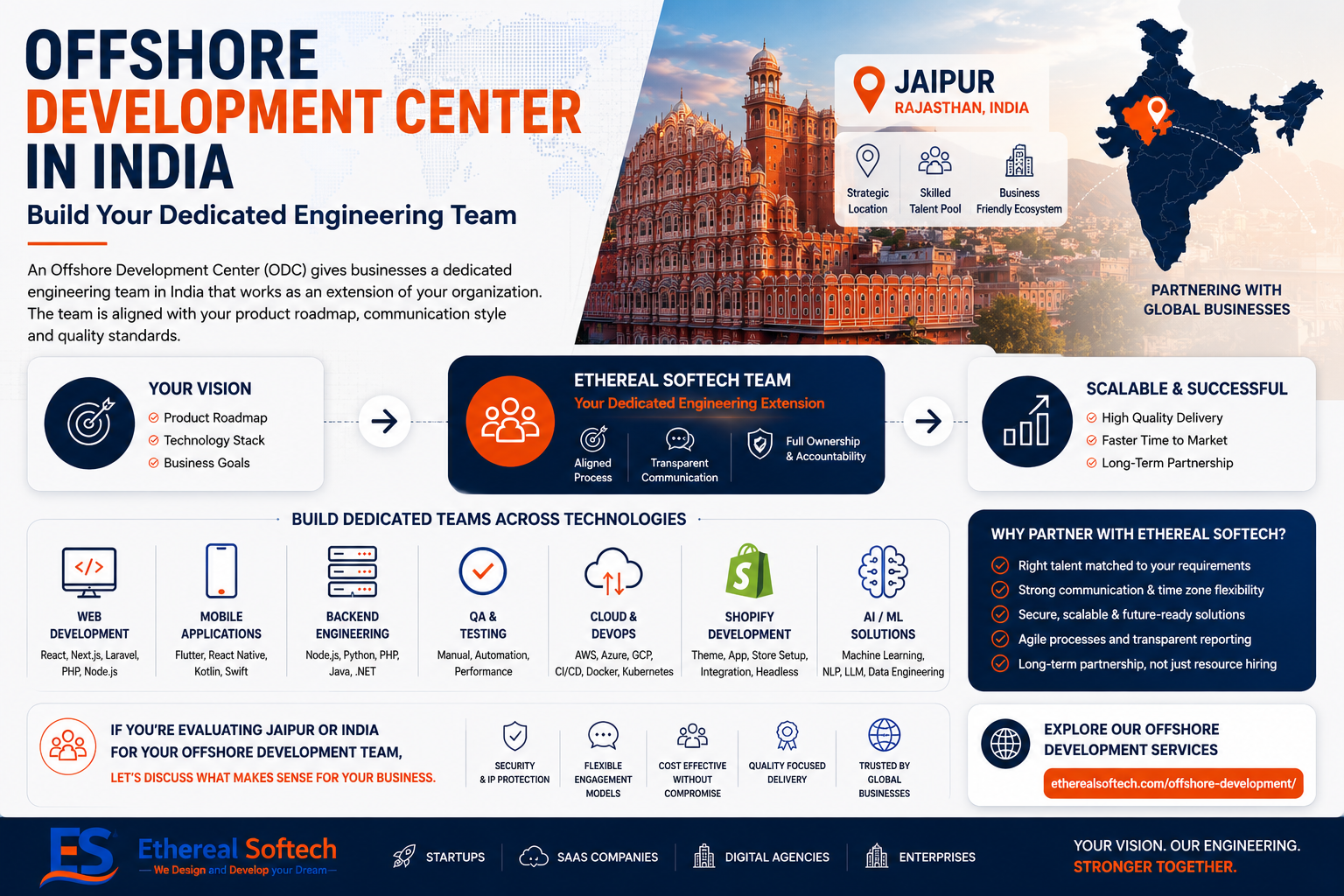
An Offshore Development Center is a dedicated engineering team located in another country and working as an extension of a company’s internal technology organization.
For a global company, an ODC in India might include backend engineers, frontend developers, mobile developers, QA engineers, DevOps specialists, cloud engineers, UI/UX designers, technical leads, architects or AI/ML engineers.
The important distinction is that an ODC is not simply a group of outsourced developers.
A properly structured ODC has:
Clear technical ownership, defined responsibilities, development standards, security controls, documentation, testing, communication processes and measurable delivery expectations.
That makes it suitable for companies with an ongoing product roadmap rather than only a one-time project.
Why Do Global Companies Choose Offshore Development in India?
The strongest reason to consider offshore development is not simply lower salaries.
It is engineering capacity.
A company in the US, UK, Europe, Canada or Australia may have excellent product leadership but face challenges hiring enough engineers locally.
An offshore team can provide additional capacity without requiring the company to immediately build an entire engineering organization in another country.
For example, a growing SaaS company might keep product management and business leadership in its home market while building a dedicated engineering team in India.
The result is not:
“We outsourced our software.”
It can instead become:
“We extended our engineering organization.”
That difference matters.
Why Consider Jaipur?
An Established IT/ITeS Ecosystem
Jaipur isn’t starting from zero.
STPI Jaipur was established in 1998 and exists specifically to support the growing IT/ITeS industry in Rajasthan. Its current services include incubation, statutory support, data communications, co-location and project management consultancy.
STPI has also described Jaipur as a location supporting IT/ITeS startups and operates a dedicated incubation facility for technology businesses.
For an international company, an established technology ecosystem matters because an ODC needs more than individual developers.
It needs an environment where companies can recruit, operate and scale.
A Growing Engineering Talent Market
STPI’s Jaipur profile describes the city as having a skilled and employable workforce for software development and other IT/ITeS activities.
For companies, the practical question isn’t whether a city has “developers.”
Every major Indian technology location does.
The question is:
Can your partner consistently identify engineers who match your actual architecture and seniority requirements?
For example, your requirements might include:
React, Node.js, Python, FastAPI, Laravel, Java, .NET, Flutter, React Native, Android, iOS, cloud, DevOps, QA automation or AI/ML.
The right ODC partner should evaluate those requirements individually rather than treating “software developer” as a single category.
Jaipur Gives You Another Option Beyond the Largest Tech Hubs
Bengaluru, Hyderabad and Pune have exceptionally deep technology ecosystems.
That is an advantage.
But a company doesn’t always need the largest possible talent market.
If your requirement is a dedicated team of 5, 10 or 20 engineers, the better question may be:
Where can we find the right people, establish a stable team and operate effectively over several years?
That is where Jaipur can become part of the conversation.
Jaipur vs Major Indian Technology Hubs
| Factor | Jaipur | Bengaluru | Hyderabad | Pune |
|---|---|---|---|---|
| Technology ecosystem | Established and growing | Very mature | Very mature | Very mature |
| Talent depth | Growing | Very high | Very high | High |
| Specialist availability | Depends on role | Very high | Very high | High |
| Startup ecosystem | Growing | Very strong | Strong | Strong |
| Enterprise ecosystem | Developing | Very strong | Very strong | Strong |
| Dedicated engineering teams | Suitable | Suitable | Suitable | Suitable |
| Best approach | Evaluate against actual requirements | Strong for deep talent needs | Strong for enterprise and large teams | Strong for product and enterprise teams |
This is not a ranking.
If you need hundreds of highly specialized engineers immediately, another technology hub may be more appropriate.
If you need a focused, dedicated engineering team and can find the required talent in Jaipur, it can be a sensible alternative.
Infrastructure Matters More Than a City Name
An ODC cannot operate effectively without reliable infrastructure.
STPI’s Jaipur center provides services including data communications, co-location and incubation. STPI also identifies Jaipur as a location connected by road, rail and air.
This matters for more than day-to-day development.
International teams may need:
Architecture workshops, leadership visits, onboarding sessions, client meetings, hiring activities and periodic face-to-face collaboration.
A location should therefore be evaluated as an operating environment—not simply as a list of available developers.
Don’t Compare ODCs Only by Developer Salary
This is one of the most important points for a CTO.
Suppose one location offers a lower developer salary.
That doesn’t automatically mean the engineering operation will cost less.
Consider:
Recruitment + salaries + management + infrastructure + software + security + onboarding + attrition + rework
This is what I would call Total Cost of Engineering.
A cheaper team can become expensive if it has high turnover, weak documentation, poor testing, repeated rework or excessive management overhead.
So instead of asking:
“How much does an offshore developer cost?”
ask:
“What will it cost us to maintain reliable engineering capacity for the next 12–24 months?”
That is a much better business decision.
Jaipur’s Technology Ecosystem Is Also Evolving
Jaipur’s technology story isn’t limited to traditional software development.
The Rajasthan AI/ML Policy 2026 includes initiatives around responsible AI, skills and capacity building, innovation, industry support and AI-related infrastructure. The policy also includes support areas covering startups, MSMEs, industries and R&D institutions.
This doesn’t mean every AI company should choose Jaipur.
Specialized AI/ML hiring still needs to be evaluated based on the actual requirements of the project.
But it does show that the wider technology ecosystem is evolving beyond conventional IT services.
What Should a Jaipur ODC Look Like?
A common mistake is to think an ODC means:
“Hire developers and start coding.”
A sustainable engineering operation needs clearer ownership.
A practical structure could look like:
- Client Product Leadership
- Engineering Manager / Technical Lead
- Frontend + Backend + Mobile Engineering
- QA + Automation
- DevOps + Cloud
- Security + Monitoring
The exact structure depends on the product.
For a small SaaS product
A team might start with:
1 Technical Lead + 2 Developers + 1 QA + shared DevOps
For a growing product
You might add:
Engineering Lead + Frontend/Backend Engineers + Mobile Engineers + QA + DevOps + UI/UX
For an enterprise product
The structure can expand into:
Engineering Manager + Solution Architect + Multiple Engineering Squads + QA Automation + DevOps/SRE + Security
The principle is simple:
Build the team around the product roadmap, not an arbitrary headcount target.
ODC vs Agency vs Remote Development Team
Before creating an ODC, make sure you actually need one.
Agency
Useful when you have a defined project and want an external team to manage delivery.
Remote Development Team
Useful when you need flexible engineering capacity without building a broader operating structure.
Offshore Development Center
Better suited to companies with an ongoing product roadmap that want a dedicated, long-term engineering capability.
Your decision should depend on how much control, continuity and ownership you need.
For a deeper comparison, see our guide to In-House vs Offshore Development Center vs Agency.
Security Should Be Part of the ODC Architecture
For an international company, security cannot be an afterthought.
Before giving an offshore team access to your product, define:
Identity and access management, MFA, repository permissions, secrets management, environment separation, production access, device security, logging, monitoring and incident response.
Also clarify:
NDA, confidentiality, IP ownership, source-code ownership and knowledge-transfer requirements.
A useful principle is:
Your security boundary isn’t the country where your developers sit. It is your identity, access, infrastructure and processes.
That is why security architecture should be designed before the team scales.
Who Owns the Source Code?
This question should be answered before development begins.
Your agreement should clearly address:
Source-code ownership
Intellectual property
Repository ownership
Cloud-account ownership
Credentials
Confidential information
Documentation
Knowledge transfer
Exit procedures
For a product company, the source code and related intellectual property are core business assets.
Don’t leave ownership assumptions to the end of the engagement.
How Do You Manage an ODC Across Time Zones?
A US or European company doesn’t need everyone online for eight identical hours every day.
A better model is:
Defined overlap hours + asynchronous communication + written documentation + clear ownership
Use your overlap window for:
Architecture discussions, sprint planning, product decisions, blockers and important reviews.
Use asynchronous communication for:
Status updates, documentation, code reviews, task discussions and recorded decisions.
This reduces unnecessary meetings while keeping the engineering organization aligned.
A Practical 90-Day ODC Setup
Days 1–30: Define the Foundation
Start with:
Product roadmap, architecture, technology stack, team structure, security requirements, hiring criteria and communication model.
Don’t hire ten developers before deciding who owns architecture.
Days 31–60: Establish the Engineering System
Set up:
Repositories, development environments, CI/CD, coding standards, code reviews, QA processes, documentation and access controls.
The goal is to make the team productive without creating dependency on one person.
Days 61–90: Move Toward Independent Delivery
The team should begin owning meaningful product work.
Measure:
Delivery predictability, quality, review cycles, defects, deployment reliability and team stability.
At this point, you have actual evidence to decide whether to scale.
How Should You Measure an ODC?
Don’t measure success by the number of developers hired.
Look at:
Release frequency, lead time, escaped defects, deployment reliability, sprint predictability, code-review turnaround, production incidents, documentation quality and team stability.
The exact KPIs should depend on your product.
The objective isn’t to make engineers write more code.
The objective is to build better software predictably.
When Does Jaipur Make Sense?
A Jaipur ODC may be worth evaluating if you:
Need a dedicated engineering team, have a long-term product roadmap, want to expand development capacity, need web or mobile engineers, require QA or DevOps capability, are building SaaS products, want to extend an existing engineering organization or need a long-term development partner in India.
It can also be relevant for international agencies that need a stable engineering team to support multiple client projects.
When Might Jaipur Not Be the Best Choice?
This is equally important.
Jaipur may not be the ideal choice if you need:
Hundreds of specialized engineers immediately, an exceptionally deep niche technology talent pool, or a very large enterprise engineering ecosystem concentrated in one location.
In those situations, Bengaluru, Hyderabad, Pune, Gurugram, Chennai or another location may deserve consideration.
The goal isn’t to prove Jaipur is better.
The goal is to find the location that fits your engineering requirements.
That is the approach a CTO should take.
How to Choose an Offshore Development Partner
Before selecting a partner, ask:
Can I interview the engineers before they join?
How are developers technically evaluated?
Who owns the source code and IP?
How is production access controlled?
How are developer replacements handled?
Who provides technical leadership?
How are architecture decisions documented?
How does the team communicate with our existing engineers?
Can the team scale when our roadmap changes?
What happens if we need to reduce or close the engagement?
The answers tell you much more than a sales deck.
Why Consider Ethereal Softech?
An offshore team should not be treated as a collection of resumes.
At Ethereal Softech, the objective is to build an engineering team around the product, technology stack, roadmap and business requirements.
Depending on the project, the team can cover:
Web development, mobile applications, Shopify, SaaS, AI/ML, backend engineering, frontend development, QA and cloud/DevOps.
For an international company, the goal is straightforward:
You retain product and business ownership while your offshore engineering team becomes a dependable extension of your technology organization.
You can explore our Offshore Development Services to understand the engagement model.
Frequently Asked Questions
Is Jaipur a good location for an Offshore Development Center?
Jaipur is worth considering for an ODC because it has an established IT/ITeS ecosystem and technology infrastructure. STPI Jaipur has supported the city’s IT/ITeS industry since 1998.
Can a US or European company build an ODC in Jaipur?
Yes. International companies can work with dedicated engineering teams in India using defined overlap hours, asynchronous communication, documentation, project management and clear technical ownership.
Is Jaipur cheaper than Bengaluru or Hyderabad?
There is no universal percentage that applies to every technology role or team. Compare total engineering cost, not just salary, including recruitment, management, infrastructure, turnover and productivity.
How many developers do I need for an ODC?
There is no fixed number. A small product may begin with a technical lead, developers and QA, while larger products may require multiple engineering squads, DevOps, security and technical leadership.
What is the difference between an ODC and outsourcing?
Outsourcing is often organized around delivering a defined project or scope. An ODC is generally structured as a dedicated, longer-term engineering capability that works as an extension of the client’s organization.
Who owns the source code developed by an offshore team?
Ownership should be clearly established in the contract. Source-code repositories, intellectual property, cloud accounts, credentials and documentation should also have clearly defined ownership and access rules.
Can an ODC in Jaipur work with US and European time zones?
Yes. A combination of defined overlap hours, asynchronous communication, documentation and clear ownership can make distributed engineering teams effective across time zones.
Is Jaipur suitable for SaaS development?
Yes, provided the required engineering skills are available. SaaS teams may require backend, frontend, mobile, cloud, DevOps, QA and product engineering capabilities depending on the architecture.
Is Jaipur suitable for AI/ML development?
Jaipur can be considered for AI/ML teams, and Rajasthan’s AI/ML Policy 2026 includes initiatives covering AI skills, innovation, industry support and capacity building. Specialized hiring should still be evaluated against the exact technical requirements of the project.
Can we start small and scale the ODC later?
Yes. For many product companies, starting with the smallest team capable of delivering the next meaningful milestone is more practical than building a large team before the engineering process is proven.
Final Thoughts
Choosing an offshore development location should not start with:
“Where can we find the cheapest developers?”
It should start with:
“Where can we build the engineering capability our product needs?”
India offers global companies an established technology ecosystem for offshore development. Within India, Jaipur provides another location worth evaluating, with an established IT/ITeS presence supported by STPI and an evolving state technology ecosystem.
But Jaipur isn’t automatically the right choice.
The decision should come down to talent, technical requirements, total engineering cost, security, communication, management, scalability and long-term product needs.
For the right organization, a Jaipur-based ODC can be much more than an outsourcing arrangement.
It can become a long-term extension of the engineering team.
Building an Offshore Development Team in India?
Tell us about your product, technology stack, current engineering team and growth plans.
Ethereal Softech can help you evaluate the right team structure and offshore engagement model for your business.