On this page
- What Is Generative AI?
- How Does Generative AI Work?
- How Does AI Training Work?
- What Are Tokens?
- What Are Embeddings?
- How Do Transformers Work?
- What Happens When You Ask an AI a Question?
- How Does an LLM Generate an Answer?
- Training vs. Inference: What’s the Difference?
- What Is Fine-Tuning?
- What Is RAG in Generative AI?
- Does RAG Train the AI Model?
- RAG vs. Fine-Tuning
- What Is Multimodal Generative AI?
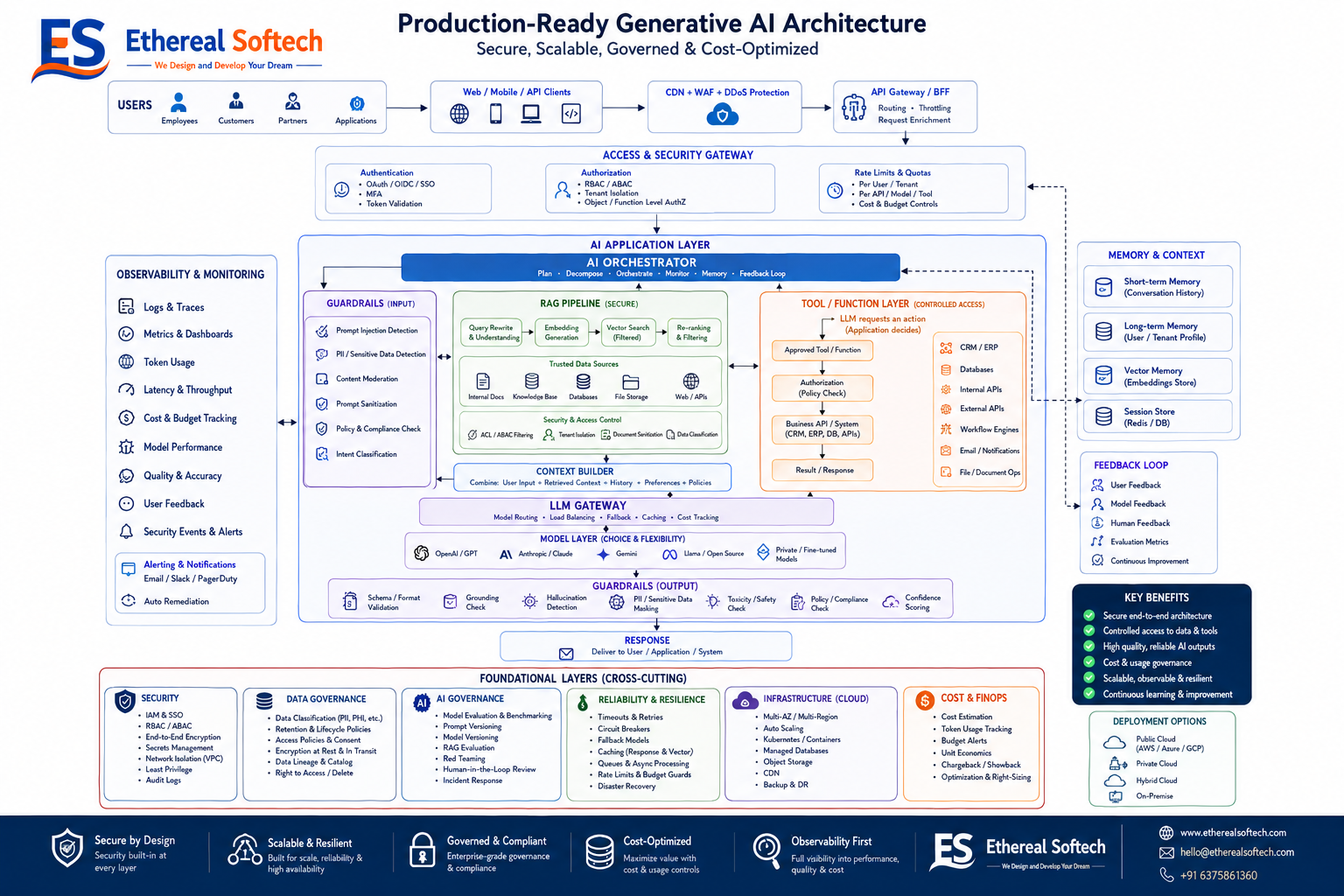
- How Does a Real Generative AI Application Work?
- What Most Businesses Get Wrong About Generative AI
- Why Does Generative AI Sometimes Give Wrong Answers?
- Real-World Generative AI Applications
- What Are the Benefits of Generative AI?
- What Are the Limitations of Generative AI?
- How to Build a Generative AI Application
- Define the Problem
- Understand the Users
- Identify the Data
- Choose the Model
- Design the Architecture
- Build an MVP
- Test With Real Examples
- Monitor Production
- Improve Continuously
- What Does a Production GenAI Technology Stack Look Like?
- What Should Developers Consider Before Launching a GenAI Product?
- How Much Does Generative AI Development Cost?
- Does a Business Need to Train Its Own AI Model?
- Is Generative AI the Same as ChatGPT?
- How Ethereal Softech Approaches Generative AI Development
- Frequently Asked Questions About Generative AI
- How does generative AI work in simple terms?
- How does an LLM generate text?
- What is the difference between AI training and inference?
- What are tokens in generative AI?
- What is a transformer model?
- What is RAG in generative AI?
- Does RAG require retraining the model?
- What is fine-tuning?
- Can generative AI use private company data?
- Does a company need its own AI model?
- How much does it cost to build a generative AI application?
- What is the biggest challenge in generative AI development?
- Final Thoughts
Generative AI has moved quickly from something people experimented with to technology businesses are actively putting into products and workflows.
You can see it in coding assistants, customer-support tools, document processing systems, search applications, content platforms, healthcare software, fintech products, and SaaS applications.
But there is still a lot of confusion about what actually happens when you type a question into an AI application.
How does generative AI work?
At a high level, generative AI learns patterns from large amounts of data and uses those patterns to generate new content when it receives an input.
For a language model, that means processing text as tokens, understanding relationships between those tokens, and generating an output one token at a time.
That explanation is technically correct, but it doesn’t tell the whole story.
If you’re building a real AI product, the model is only one part of the system. You also have to think about data, retrieval, APIs, security, application logic, cost, monitoring, and what happens when the model gets something wrong.
This guide explains how the technology works and, more importantly, what developers and businesses should understand before putting generative AI into production.
What Is Generative AI?
Generative AI is a type of artificial intelligence that creates new content from information it has learned during training and the context provided at runtime.
The output can be different depending on the model.
It may generate text, software code, images, audio, speech, video, or structured information.
A traditional machine learning model might be trained to determine whether a transaction is potentially fraudulent.
A generative AI application could take transaction information and produce an explanation, summarize a customer’s activity, or help an analyst investigate a case.
These are different types of problems.
Generative AI is particularly useful when the system needs to create, transform, summarize, explain, or interact with information rather than simply classify it.
How Does Generative AI Work?
The easiest way to understand how generative AI works is to separate the process into two stages:
Training and inference.
During training, the model learns patterns from large datasets.
During inference, the trained model uses those learned patterns to respond to a new input.
A simplified workflow looks like this:
Training data → Model training → Learned parameters → Trained model
Then, when a user interacts with the model:
User input → Tokenization → Model processing → Next-token prediction → Generated output
Modern systems add considerably more around this basic process.
For example, a business application may retrieve information from its own database before sending a request to the model. It may also call external APIs, apply business rules, validate the output, and log the interaction.
That’s why a production generative AI application is much more than an API call to an LLM.
How Does AI Training Work?
Before an AI model can generate useful responses, it needs to learn from data.
During training, the model processes examples and adjusts its internal parameters so that its predictions become more accurate.
For language models, one important part of this process involves predicting tokens based on the surrounding context.
Consider this sentence:
“The developer deployed the application to the ___.”
The model learns patterns that make certain continuations more likely.
It does this across an enormous amount of training data.
The model isn’t simply building a huge collection of sentences that it searches whenever someone asks a question.
Instead, training changes the model’s parameters so it can represent patterns and relationships in the data.
This is one reason a trained model can generate a sentence it has never seen before.
What Are Tokens?
When you type a question into an AI application, the model doesn’t usually process the entire sentence as one object.
The text is broken into smaller pieces called tokens.
A token can represent a complete word, part of a word, punctuation, or another piece of text depending on the tokenizer.
For example, a sentence such as:
“Generative AI helps developers build applications.”
is converted into a sequence of tokens before being processed.
Those tokens are then represented numerically so the neural network can work with them.
Tokens are also important from a practical perspective.
Many AI APIs charge based partly on input and output token usage. That means long prompts, large conversation histories, and large amounts of retrieved information can increase both latency and cost.
For developers building AI products, token management isn’t just a theoretical concept. It can directly affect the application’s operating cost.
What Are Embeddings?
Embeddings are numerical representations of information.
Text, documents, images, and other data can be converted into vectors that capture useful relationships between pieces of information.
This becomes particularly useful when you need to search by meaning rather than exact words.
Imagine an employee asks:
“How can I recover access to my account?”
Your internal documentation might contain a page called:
“Credential Recovery Procedure”
The wording is different, but the meaning is closely related.
A semantic search system can use embeddings to identify that relationship.
Embeddings are therefore commonly used in:
Semantic search, recommendation systems, document retrieval, similarity search, clustering, and RAG applications.
How Do Transformers Work?
Modern large language models commonly use transformer-based architectures.
One of the most important ideas behind transformers is attention.
Attention allows the model to evaluate relationships between different parts of the input.
Take a sentence such as:
“The developer moved the server because it was overheating.”
To understand what “it” refers to, the model needs to consider the surrounding context.
Attention mechanisms help the model determine which tokens are relevant to one another.
A transformer processes these representations through multiple layers, gradually building more useful representations of the input.
The model learns these relationships during training.
This architecture has been one of the major reasons modern language models have become capable of handling increasingly complex language tasks.
What Happens When You Ask an AI a Question?
Now let’s look at what happens after training.
Suppose you ask:
“Explain APIs to a startup founder.”
The application first processes your request.
A simplified flow looks like this:
- Your prompt
- Tokenization
- Numerical representations
- Transformer processing
- Context evaluation
- Next-token prediction
- Token generation
- More predictions
- Final response
The model generates the response progressively.
It predicts a likely next token based on the context, adds that token to the sequence, and then predicts what should come next.
This happens extremely quickly, which is why the interaction feels conversational.
How Does an LLM Generate an Answer?
A large language model doesn’t normally decide the entire answer before producing the first word.
It generates the response progressively.
Imagine the model has produced:
“An API allows two software systems to…”
The model evaluates possible next tokens.
One likely continuation could be:
“communicate”
That token becomes part of the context.
The model then predicts the next token.
This continues until the response reaches an appropriate stopping point.
This doesn’t mean an LLM is simply guessing randomly.
Its predictions are influenced by the model’s learned parameters, the prompt, the available context, and the decoding process used by the application.
That is also why changing the prompt or surrounding context can significantly change the response.
Training vs. Inference: What’s the Difference?
These two terms are easy to mix up.
Training is where the model learns.
Inference is where the trained model is used.
| Training | Inference |
|---|---|
| Learns patterns from data | Uses the trained model |
| Adjusts model parameters | Normally doesn’t change parameters |
| Happens during model development | Happens when users make requests |
| Can require significant computing resources | Requires computing for each request |
| Produces the trained model | Produces the model’s output |
When you ask a question through an AI application, the model is normally performing inference.
It isn’t retraining itself from scratch for every question.
What Is Fine-Tuning?
Sometimes a general-purpose model isn’t enough.
A company may want a model to behave in a particular way, follow a specific format, or perform a specialized task.
That’s where fine-tuning can be useful.
Fine-tuning involves additional training using a targeted dataset to adapt an existing model.
However, fine-tuning is often misunderstood.
If your problem is:
“The model doesn’t know about our latest internal policies.”
Fine-tuning may not be the first solution to consider.
If your problem is:
“The model needs to consistently follow a particular learned behavior or output pattern.”
Fine-tuning may be more relevant.
For changing business information, retrieval is often a better architectural fit than repeatedly retraining the model.
What Is RAG in Generative AI?
RAG stands for Retrieval-Augmented Generation.
RAG allows an AI application to retrieve relevant information from an external knowledge source and provide that information to the model before generating an answer.
This is particularly useful when the model needs information that isn’t reliably available from its original training.
A typical RAG workflow looks like this:
- Company documents
- Document processing
- Chunking
- Embeddings
- Search / Vector database
- User question
- Relevant information retrieved
- Context sent to the LLM
- Generated answer
For example, imagine a company has 20,000 internal documents.
An employee asks:
“What is our current employee reimbursement policy?”
The system can search the company’s knowledge base, retrieve the relevant policy, and provide that information to the model as context.
The model can then generate a response based on the retrieved material.
RAG is commonly used for enterprise knowledge assistants, document search, customer support, internal tools, and domain-specific AI applications.
Does RAG Train the AI Model?
No.
This is an important distinction.
A typical RAG implementation doesn’t modify the underlying model when a new document is added.
Instead, the document is processed and added to the application’s searchable knowledge source.
When someone asks a question, the application retrieves the relevant information at runtime.
That means a company can update its knowledge base without necessarily retraining its foundation model.
This is one reason RAG is attractive for businesses that work with information that changes regularly.
RAG vs. Fine-Tuning
RAG and fine-tuning solve different problems.
| Business requirement | Possible approach |
|---|---|
| Access current company documents | RAG |
| Search private knowledge | RAG |
| Retrieve relevant information | RAG |
| Change model behavior | Fine-tuning |
| Teach a particular output style | Fine-tuning may help |
| Connect AI to another application | API/tool integration |
| Automate a business workflow | AI + application logic |
In some systems, you may use more than one approach.
For example:
LLM + RAG + APIs + business rules + authentication
can form a complete AI application.
The right architecture depends on the actual problem.
What Is Multimodal Generative AI?
Generative AI isn’t limited to text.
Modern AI systems can work with different types of information, including:
Text, images, audio, speech, video, and structured data.
This is known as multimodal AI.
Consider a business that receives invoices as images or PDFs.
A multimodal AI workflow could potentially understand the document, identify relevant information, structure the data, and pass it to another application.
Other use cases include:
Image analysis, document intelligence, voice applications, visual customer support, education, accessibility, and multimedia search.
The engineering challenge becomes more complex because different data types may require different processing pipelines.
How Does a Real Generative AI Application Work?
This is where the difference between an AI demo and a real product becomes obvious.
A simple demo might look like:
User → LLM API → Response
A production application may look more like:
- User
- Web / Mobile App
- Backend
- Authentication
- Prompt & Context Management
- RAG / Search
- Database / Business APIs
- LLM
- Validation / Guardrails
- Response
- Logging / Monitoring / Evaluation
The model is only one part of that architecture.
For example, an AI customer-support application may need access to customer records.
An internal company assistant needs employee permissions.
A financial application may need strict validation before an AI-generated result reaches a customer.
A SaaS product needs user management, billing, usage tracking, and infrastructure.
The AI model doesn’t solve these problems by itself.
That’s where software engineering becomes just as important as model selection.
What Most Businesses Get Wrong About Generative AI
One of the easiest mistakes to make is starting with the technology.
A team chooses a model and then tries to find a problem for it to solve.
A better approach is to start with the workflow.
Ask:
Where is the user losing time?
Where is the existing process repetitive?
What information is difficult to access?
What decision requires too much manual work?
Can AI actually improve that process?
For example, if employees spend hours copying information from one system to another, a chatbot might not be the best solution.
An automated API workflow could be much more useful.
Similarly, if a company simply needs to search a structured database, adding an LLM may introduce unnecessary complexity.
Good AI engineering isn’t about adding AI everywhere.
It’s about finding the places where AI genuinely improves the product or workflow.
Why Does Generative AI Sometimes Give Wrong Answers?
Generative AI can produce answers that sound convincing but contain incorrect information.
This is commonly called a hallucination.
A language model is designed to generate a useful continuation based on patterns and context. It isn’t automatically a verified source of truth.
That’s why production applications often need additional safeguards.
Depending on the use case, those can include:
RAG, source references, structured outputs, validation rules, API calls, retrieval filters, evaluation datasets, human review, permissions, and monitoring.
The amount of control required depends on the consequences of an incorrect answer.
An AI application generating marketing copy doesn’t have the same risk profile as one assisting with a financial or healthcare workflow.
Real-World Generative AI Applications
Generative AI is being used across many industries, but the most useful applications tend to solve specific problems rather than simply adding a chatbot.
Customer Support
AI can help agents search documentation, summarize conversations, draft responses, and handle repetitive questions.
Software Development
Developers can use AI for code generation, documentation, code explanation, testing assistance, and debugging.
Healthcare
AI can support document summarization, information retrieval, administrative workflows, and other use cases where appropriate safeguards and human oversight are applied.
Banking and FinTech
Potential applications include document processing, knowledge assistants, customer support, reporting, and analyst workflows.
E-commerce
Generative AI can support product content, customer interactions, search, recommendations, and merchandising workflows.
Education
AI can generate explanations, practice material, summaries, and personalized learning experiences.
Enterprise Knowledge
Employees can ask natural-language questions about internal policies, documentation, procedures, and company knowledge.
The technology is broad.
The business use case should be specific.
What Are the Benefits of Generative AI?
When implemented correctly, generative AI can help businesses in several ways.
Reduce repetitive work by assisting with drafting, summarization, classification, and transformation.
Improve access to information by allowing people to search large knowledge bases using natural language.
Support developers with coding, testing, documentation, and debugging assistance.
Automate workflows when AI is connected to business APIs and applications.
Create better user experiences through conversational interfaces and personalized interactions.
But these benefits don’t come automatically from using an LLM.
The application still needs to be designed around a real business outcome.
What Are the Limitations of Generative AI?
Generative AI is powerful, but it isn’t a replacement for good engineering.
Accuracy
AI-generated information can be incorrect.
Cost
High usage, large context windows, retrieval, and infrastructure can increase operating costs.
Latency
More complex AI workflows can take longer to respond.
Privacy
Sensitive data needs appropriate access controls and governance.
Reliability
External model APIs and supporting services can fail.
Evaluation
It’s harder to test an AI system when several different responses may be acceptable.
Security
AI applications can introduce additional security considerations around prompts, data access, tool use, and external integrations.
These limitations should be considered during architecture design rather than after the product is already live.
How to Build a Generative AI Application
A practical GenAI project usually starts with the business problem.
Define the Problem
Be specific about what you want to improve.
“Use AI in our business” isn’t a product requirement.
“Reduce the time support agents spend searching documentation” is much more useful.
Understand the Users
Who will use the system?
What information do they need?
What will they do with the AI-generated result?
Identify the Data
Determine whether the application needs:
Public information, internal documents, databases, APIs, real-time data, or user-provided information.
Choose the Model
Compare models based on:
Capability, cost, latency, context requirements, privacy, deployment options, and expected workload.
Design the Architecture
Decide where the model fits with:
Backend, databases, RAG, APIs, authentication, business logic, monitoring, and security.
Build an MVP
Start with one valuable workflow instead of trying to build an AI platform with twenty features.
Test With Real Examples
Create realistic test cases.
Don’t judge the product because it gave three impressive answers in a demo.
Monitor Production
Track:
Quality, latency, errors, token usage, costs, retrieval performance, and user feedback.
Improve Continuously
AI products usually require ongoing work on prompts, retrieval, models, data, workflows, and user experience.
What Does a Production GenAI Technology Stack Look Like?
There isn’t one universal stack for generative AI development.
A product might use:
Frontend: React, Next.js, Flutter, or another suitable framework
Backend: Python/FastAPI, Node.js, Laravel, or another backend technology
AI: Foundation model APIs or self-hosted models
Knowledge layer: Vector database, search engine, or hybrid retrieval
Database: PostgreSQL, document database, or an existing enterprise database
Infrastructure: AWS, Azure, Google Cloud, or another cloud platform
Integrations: Internal APIs and third-party business services
Monitoring: Application logs, traces, performance monitoring, cost monitoring, and AI evaluation
The important part isn’t choosing the trendiest technology.
It’s choosing a stack that fits the product.
What Should Developers Consider Before Launching a GenAI Product?
Getting an AI model to generate an answer is relatively easy.
Making that answer reliable inside a real application is harder.
Before launching, developers should ask:
How fast does the response need to be?
What happens when the model gives a bad answer?
Who is allowed to access the data?
What information is sent to the model?
How much will each request cost?
How will response quality be measured?
What happens if the AI provider is unavailable?
Can users or administrators review important AI-generated decisions?
How will the system be monitored after launch?
These questions are often more important than the model name itself.
How Much Does Generative AI Development Cost?
There is no single price for building a generative AI application.
A small AI feature and a large enterprise platform can have completely different requirements.
Development cost depends on factors such as:
Application complexity, model selection, number of users, integrations, data volume, RAG requirements, infrastructure, security, UI/UX, testing, monitoring, and ongoing AI usage.
For startups, building a focused MVP is often a better starting point than investing heavily in a large AI platform before the use case has been validated.
Does a Business Need to Train Its Own AI Model?
Usually, no.
Most businesses don’t need to train a foundation model from scratch.
They can use an existing model and build their own application around it.
That application can include:
Private data, RAG, APIs, databases, business rules, authentication, workflows, monitoring, and custom user experiences.
Training a foundation model from scratch is a very different undertaking and requires substantial data, infrastructure, computing resources, and specialized expertise.
For most businesses, the more practical question is:
How can we build a useful product around an appropriate existing model?
Is Generative AI the Same as ChatGPT?
No.
ChatGPT is an AI product. Generative AI is the broader technology category.
A business can use generative AI models to build its own application.
For example, an enterprise could create an internal assistant with:
Employee authentication + company documents + RAG + LLM + internal APIs + audit logs + web application
That would be a custom generative AI application.
The company doesn’t need to build a foundation model from scratch to create a valuable AI product.
How Ethereal Softech Approaches Generative AI Development
At Ethereal Softech, we don’t start an AI project by asking which model is currently popular.
We start by understanding the product.
What are users trying to accomplish?
Where is the existing workflow slow or expensive?
What information does the system need?
Does the application need RAG?
Does it need an API integration?
Does it actually need an LLM, or would a conventional software solution work better?
Depending on the project, our team can work on Generative AI applications, LLM-powered software, RAG systems, AI assistants, document intelligence, AI-enabled SaaS products, workflow automation, and custom AI integrations.
We can also work across technologies such as Python/FastAPI, Node.js, Laravel, Flutter, React Native, AWS, Shopify, and modern AI technologies, depending on the product requirements.
The goal isn’t to make a product look more “AI-powered.”
The goal is to make the product more useful, efficient, and scalable.
Sometimes that means using an LLM.
Sometimes it means RAG.
Sometimes it means connecting AI to existing APIs.
And sometimes the best answer is not to use AI at all.
Good AI engineering starts with the problem, not the model.
Frequently Asked Questions About Generative AI
How does generative AI work in simple terms?
Generative AI learns patterns from large amounts of data and uses those patterns to create new content from an input. For language models, the input is processed as tokens and the response is generated progressively.
How does an LLM generate text?
An LLM processes the input as tokens, evaluates relationships within the available context, predicts possible next tokens, and generates the response progressively until it reaches a stopping condition.
What is the difference between AI training and inference?
Training is the process of teaching a model patterns by adjusting its parameters using data. Inference is the process of using the trained model to generate an output from new input.
What are tokens in generative AI?
Tokens are pieces of text processed by language models. A token may represent a word, part of a word, punctuation, or another text segment depending on the tokenizer.
What is a transformer model?
A transformer is a neural-network architecture used by many modern language models. Its attention mechanisms help the model understand relationships between different parts of the input context.
What is RAG in generative AI?
RAG, or Retrieval-Augmented Generation, retrieves relevant information from an external knowledge source and provides it to a generative model as context when generating a response.
Does RAG require retraining the model?
Usually not. A typical RAG system retrieves information during inference instead of modifying the underlying model parameters.
What is fine-tuning?
Fine-tuning is additional training performed on an existing model using targeted data to adapt its behavior to a particular task, format, or domain.
Can generative AI use private company data?
Yes. Applications can connect generative AI to private information through controlled data sources, RAG, APIs, and databases. Security, access control, privacy, and governance should be designed around the specific use case.
Does a company need its own AI model?
Usually not. Many businesses can build useful AI products using existing foundation models combined with their own data, application logic, APIs, retrieval systems, and workflows.
How much does it cost to build a generative AI application?
The cost depends on the application’s complexity, model usage, data, integrations, infrastructure, security, user volume, and ongoing AI costs. There is no universal development price.
What is the biggest challenge in generative AI development?
The hardest part is often not connecting to an AI model. The challenge is building a complete system that is reliable, secure, cost-effective, measurable, and useful within a real business workflow.
Final Thoughts
Generative AI looks simple when you’re using it.
You type something.
The system responds.
Behind that response is a much larger technology stack involving training data, model parameters, tokens, transformers, inference, retrieval, APIs, databases, application logic, security, and monitoring.
And that’s the part businesses need to understand.
Building a quick AI demo is one thing.
Building an AI product that customers can trust is another.
The model matters, but so do the systems around it.
Before choosing an LLM, think about the problem, the users, the data, the workflow, the risks, and the expected business outcome.
Then choose the technology that actually fits.
The best generative AI product isn’t necessarily the one using the biggest model. It’s the one that solves a real problem reliably.
If you’re planning an AI-powered SaaS product, RAG application, LLM solution, document intelligence platform, AI assistant, or custom generative AI workflow, Ethereal Softech can help evaluate the use case, define the architecture, and build the product around it.
Build AI around the problem—not the other way around.