
On this page
- What Makes a Technology Stack Cost-Effective?
- Flutter + Node.js + PostgreSQL
- React + Node.js + MongoDB
- Flutter + Laravel + MySQL
- React + FastAPI + PostgreSQL
- Kotlin + Spring Boot + PostgreSQL
- Tech Stack Comparison
- Which Tech Stack Is Cheapest for an MVP?
- How to Choose the Right Tech Stack for a Startup
- Which platforms are required?
- How complex is the product?
- What type of data will you manage?
- Does the product actually require AI?
- What are the security requirements?
- How quickly do you need to validate the product?
- Can you maintain the stack?
- Don’t Over-Engineer the MVP
- What Happens If the Product Succeeds?
- The Hidden Cost of a Tech Stack
- A Better Technology Selection Process
- Practical Recommendations
- Frequently Asked Questions
- What is the most cost-effective tech stack for startups?
- Which tech stack is best for an MVP?
- Is Flutter cheaper than native mobile development?
- Is PostgreSQL expensive?
- Is MongoDB better than PostgreSQL?
- Is Node.js good for startup applications?
- Is FastAPI suitable for production?
- Should startups use microservices from the beginning?
- How should a startup choose between PostgreSQL and MongoDB?
- Does the cheapest technology stack reduce the overall product cost?
- Final Thoughts
- How Ethereal Softech Helps Startups Choose the Right Technology
Choosing a technology stack is one of the first important technical decisions a startup makes.
It affects much more than the initial development budget. Your technology choices can influence development speed, hiring, infrastructure, security, maintenance, scalability, and how easily the product can evolve as requirements change.
That is why choosing a stack simply because it is popular—or because developers are available at a lower cost—is rarely enough.
A better question is:
Which technology stack can meet the product’s requirements while keeping its overall cost and complexity reasonable over time?
There is no universal answer. A mobile-first marketplace, AI SaaS platform, internal business application, and fintech product can have completely different architectural requirements.
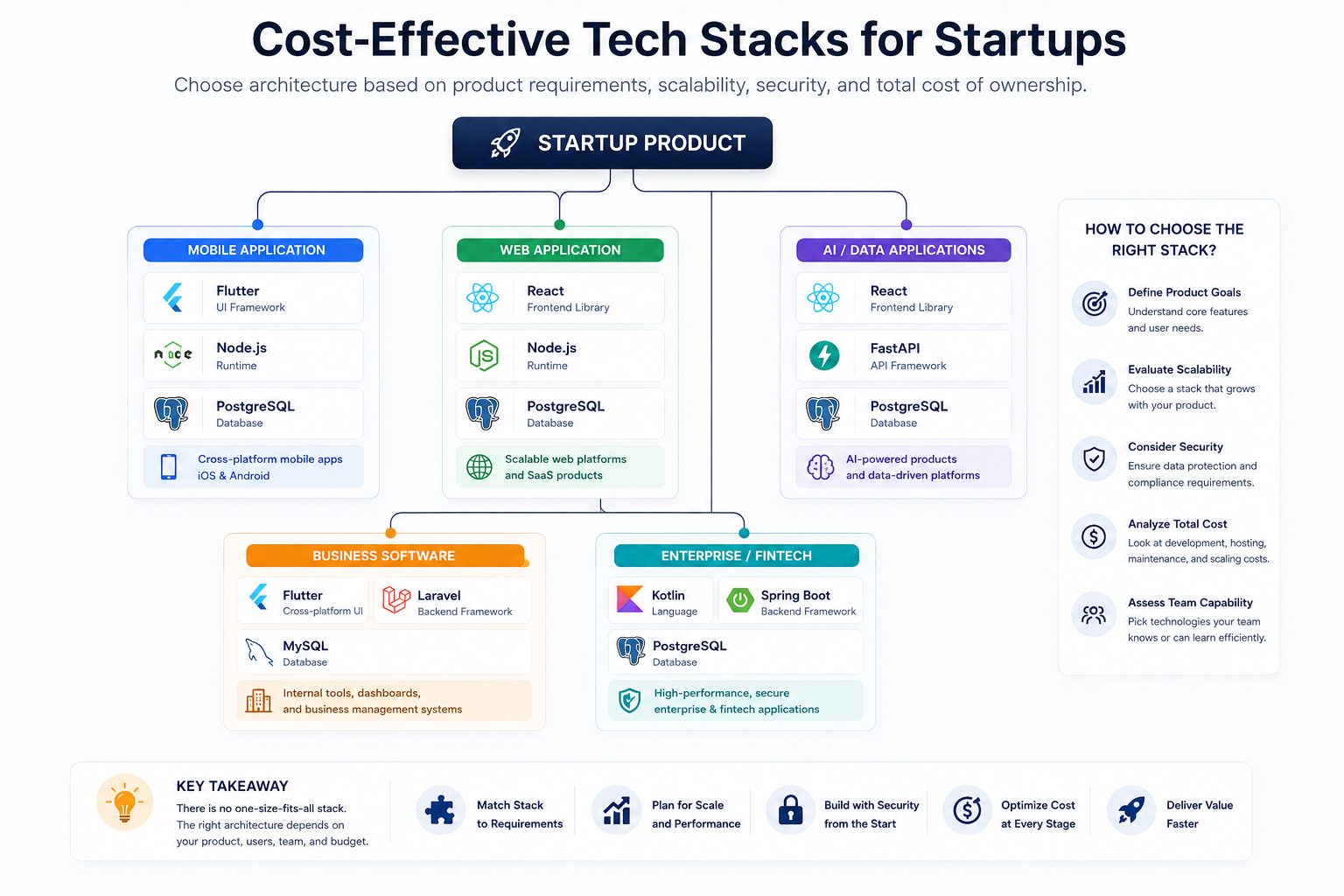
This guide compares five practical technology combinations and explains where each can make sense for a startup.
What Makes a Technology Stack Cost-Effective?
A cost-effective stack is not necessarily the one with the lowest development quote.
You need to consider development effort, developer availability, infrastructure, security, testing, maintenance, integrations, operational complexity, scalability requirements, and future changes.
For example, PostgreSQL is free and open source, but operating a production database still involves infrastructure, storage, backups, monitoring, security, and administration. PostgreSQL itself provides a mature relational database system with a strong focus on reliability, data integrity, extensibility, and complex workloads.
Similarly, Flutter can allow teams to build multi-platform applications from a shared codebase, but platform-specific integrations may still require native Android or iOS code.
So the goal should be:
Minimize unnecessary total cost and complexity without compromising the product’s actual requirements.
Flutter + Node.js + PostgreSQL
Best suited to: Mobile-first SaaS, marketplaces, booking and on-demand applications
For a startup where Android and iOS are both important, Flutter + Node.js + PostgreSQL can be a practical combination.
A simplified architecture might look like:
Android / iOS
      ↓
   Flutter
      ↓
    API
      ↓
  Node.js
      ↓
 PostgreSQL
Flutter supports building, testing, and deploying multi-platform applications from a single codebase, while also providing mechanisms for platform-specific integrations when required.
Node.js is an asynchronous, event-driven JavaScript runtime designed for network applications and can be suitable for API-driven and real-time workloads.
PostgreSQL provides a mature relational data model that can be useful when the application has structured data, transactions, relationships, and strong consistency requirements.
Why it can be cost-effective
The main potential advantage is reducing duplicated development effort on the mobile side.
Instead of maintaining completely separate application implementations for Android and iOS, a team can share much of the Flutter application code while using native integrations where the operating system requires them.
On the backend, Node.js can handle APIs, authentication, integrations, notifications, real-time functionality, and application services.
Where it can work well
SaaS applications, marketplaces, booking platforms, delivery applications, subscription products, customer-facing mobile apps, and mobile-first startups.
Senior architecture consideration
Don’t introduce microservices simply because you expect the product to grow.
For an early-stage product, a modular monolith may be a more appropriate starting point:
Flutter
   ↓
Node.js Modular Backend
   ↓
PostgreSQL
If the product later develops genuine requirements for independent scaling, deployment, ownership, or fault isolation, individual components can be separated.
Verdict
A practical option for mobile-first startups when the product requirements and team’s capabilities align with Flutter and Node.js.
React + Node.js + MongoDB
Best suited to: Web-first SaaS, dashboards and applications with flexible data structures
React + Node.js + MongoDB is a common combination for web applications.
However, it is important not to treat “MERN” as an architecture by itself.
React provides the UI layer, while Node.js can provide backend services and APIs. MongoDB provides a document-oriented database model.
A simplified architecture could be:
Web Application
      ↓
    React
      ↓
   API Layer
      ↓
   Node.js
      ↓
   MongoDB
For production React applications, the surrounding application architecture also matters. React’s current documentation recommends considering an appropriate framework when creating a new application.
MongoDB’s document model can be useful when application data naturally fits flexible documents and embedded structures.
Why it can be cost-effective
A JavaScript/TypeScript-oriented development environment can simplify team organization, tooling, onboarding, and hiring when the team’s skills already align with that ecosystem.
MongoDB can also reduce friction when the application’s domain naturally maps to documents rather than highly relational structures.
But don’t choose MongoDB automatically
The database should follow the data model.
For example, an application containing:
customers, accounts, invoices, payments, settlements, and reconciliation
may have strong relational requirements.
In such a system, a relational database such as PostgreSQL may be a more natural starting point.
Where it can work well
Web SaaS, content platforms, dashboards, marketplaces, and applications where a document-oriented model fits the domain.
Verdict
A reasonable option for web-first startups when the application benefits from React and a document-oriented data model.
Flutter + Laravel + MySQL
Best suited to: Business applications, CRM, ERP, e-commerce and operational software
Many startup products are fundamentally business applications.
They may contain:
customers, products, orders, invoices, subscriptions, inventory, roles, permissions, workflows, and reports.
For this type of product, Flutter + Laravel + MySQL can be a practical combination.
A typical architecture:
Flutter
   ↓
Laravel API
   ↓
MySQL
Why it can be cost-effective
The combination can work well when:
the application has conventional business workflows, the data is primarily relational, mobile applications are required, and the development team has strong Laravel experience.
Laravel can provide the backend application layer, while MySQL handles relational data and Flutter can provide the mobile application layer.
Where it can work well
CRM systems, ERP modules, inventory applications, e-commerce platforms, booking systems, customer portals, and internal business applications.
Important consideration
Developer availability alone shouldn’t determine the technology choice.
Also evaluate:
team expertise, application complexity, security requirements, integrations, deployment model, expected traffic, and long-term maintenance.
A lower development rate does not automatically mean lower total cost.
Verdict
A practical choice for conventional business software when the product and team’s experience fit the ecosystem.
React + FastAPI + PostgreSQL
Best suited to: AI products, analytics platforms, automation and data-heavy SaaS
When Python is an important part of the product, React + FastAPI + PostgreSQL can provide a coherent architecture.
For example:
React
  ↓
FastAPI
  ↓
PostgreSQL
  ↓
AI / ML / Data Services
The main advantage isn’t simply that FastAPI is a Python API framework.
It is that Python can remain close to the product’s core technology when the system also requires:
machine learning, data processing, automation, computer vision, analytics, or model inference.
Example architecture
Consider an AI document-processing platform:
Web Application
      ↓
    FastAPI
      ↓
   Job Queue
      ↓
Background Worker
      ↓
AI / Document Processing
      ↓
PostgreSQL / Object Storage
Long-running AI or data-processing operations do not necessarily belong inside a synchronous HTTP request.
Depending on the workload, background workers and queues may provide a better architecture.
Why it can be cost-effective
If Python is already required for the core AI or data workloads, keeping the API layer within the same ecosystem can reduce unnecessary technology boundaries.
That doesn’t mean FastAPI is automatically cheaper for every startup.
Where it can work well
AI SaaS, document processing, analytics products, automation platforms, machine-learning applications, and data-heavy products.
Verdict
A strong candidate when Python is strategically important to the product rather than simply being added because AI is on the roadmap.
Kotlin + Spring Boot + PostgreSQL
Best suited to: FinTech, enterprise software and complex transactional systems
Some startups have requirements where minimizing the initial development cost should not be the only objective.
FinTech and enterprise applications are good examples.
They may require:
strong data integrity, complex business rules, authentication, authorization, auditability, transaction processing, reliability, observability, and long-term maintainability.
For these products, Kotlin + Spring Boot + PostgreSQL can be a suitable architecture.
A simplified architecture:
Web / Mobile Client
        ↓
     API Layer
        ↓
   Spring Boot
        ↓
    PostgreSQL
        ↓
 External Services
Kotlin is designed for server-side development and integrates with the Java ecosystem, including Spring. Spring Boot provides production-oriented features for application development and operations.
Why it can make financial sense
This may not be the cheapest choice for a simple MVP.
But if the product has significant business logic, transaction requirements, integrations, and reliability expectations, the additional engineering investment may be justified.
The relevant question becomes:
What architecture provides an appropriate balance between initial investment and long-term engineering risk?
Where it can work well
FinTech platforms, enterprise SaaS, payment systems, banking integrations, insurance platforms, and complex B2B applications.
Verdict
A suitable option for complex systems where reliability, maintainability, and structured backend engineering are important requirements.
Tech Stack Comparison
| Tech Stack | Suitable For | Complexity | Data Model | Main Consideration |
|---|---|---|---|---|
| Flutter + Node.js + PostgreSQL | Mobile-first SaaS | Low–Medium | Relational | Shared mobile development |
| React + Node.js + MongoDB | Web-first SaaS | Low–Medium | Document | Flexible data structures |
| Flutter + Laravel + MySQL | Business applications | Low–Medium | Relational | Practical business development |
| React + FastAPI + PostgreSQL | AI/Data products | Medium | Relational | Python ecosystem alignment |
| Kotlin + Spring Boot + PostgreSQL | FinTech/Enterprise | Medium–High | Relational | Complex business requirements |
These are directional architectural comparisons, not guarantees of cost, performance, or scalability.
Actual results depend on application design, workload, developer expertise, infrastructure, testing, security, and operational practices.
Which Tech Stack Is Cheapest for an MVP?
There isn’t one universally cheapest option.
For a mobile-first MVP, Flutter may reduce duplicated application development.
For a web-first SaaS, React with an appropriate production architecture may be suitable.
For an AI-heavy product, React + FastAPI + PostgreSQL can make sense when Python is central to the product.
For conventional business applications, Laravel + MySQL may be practical when the team has strong experience with that ecosystem.
For complex financial or enterprise products, Kotlin + Spring Boot + PostgreSQL may involve greater initial engineering effort but can be appropriate when the requirements justify it.
So instead of asking:
“Which stack is cheapest?”
ask:
“Which stack allows us to validate the product without creating unnecessary complexity or technical debt?”
How to Choose the Right Tech Stack for a Startup
Technology selection should begin with the product—not the framework.
Which platforms are required?
Do you need:
Android, iOS, web, desktop, or multiple platforms?
Cross-platform development can reduce duplicated work in some scenarios, but platform-specific capabilities may still require native implementation.
Flutter explicitly supports platform-specific integrations alongside its multi-platform development model.
How complex is the product?
A simple booking application and a payment platform may both be called SaaS, but their technical requirements can be dramatically different.
Consider:
business rules, integrations, concurrency, data sensitivity, transaction requirements, reporting, offline requirements, and expected growth.
What type of data will you manage?
Database selection should follow the workload.
Ask whether your application primarily needs:
relational data, document data, analytical workloads, geospatial queries, time-series processing, or high-volume transactions.
Do not select a database simply because it appears frequently in startup technology lists.
Does the product actually require AI?
If AI is central to the product, Python may be strategically useful.
But adding a Python service simply because AI might be introduced sometime in the future can add unnecessary operational complexity.
Choose based on realistic product requirements.
What are the security requirements?
Security should influence architecture from the beginning.
Consider:
authentication, authorization, encryption, secrets management, audit logging, data retention, privacy, dependency security, secure deployment, and regulatory requirements.
A fintech application should not be architected like a simple content website.
How quickly do you need to validate the product?
An early-stage startup needs the ability to iterate.
The architecture should support:
rapid development, automated testing, straightforward deployment, observability, and controlled technical debt.
That doesn’t mean building every enterprise capability on day one.
Can you maintain the stack?
Consider:
developer availability, senior engineering talent, ecosystem maturity, onboarding time, documentation, hiring difficulty, and future maintenance.
A technology that is easy to start with but difficult to staff later can create significant long-term costs.
Don’t Over-Engineer the MVP
One of the most common architectural mistakes is assuming that more infrastructure means better engineering.
It doesn’t.
A startup may begin with:
Client
  ↓
API
  ↓
Modular Monolith
  ↓
Database
That can be completely appropriate.
The application can still have clear internal boundaries:
Authentication
Users
Products
Orders
Payments
Notifications
Reporting
Later, if a particular module genuinely needs independent scaling, deployment, ownership, or fault isolation, it can be extracted.
Start simple. Design for evolution.
That’s very different from designing a system that is intentionally difficult to change.
What Happens If the Product Succeeds?
This is an important architecture question.
An MVP might start with:
Client
   ↓
API
   ↓
Application
   ↓
Database
As usage increases, the architecture may evolve:
Clients
   ↓
Load Balancer / API Gateway
   ↓
Application Services
   ├── Authentication
   ├── Users
   ├── Orders
   ├── Payments
   ├── Notifications
   └── Analytics
          ↓
 Database / Cache / Queue / Storage
But this evolution should be driven by actual requirements and observed bottlenecks, not by assumptions.
There is no architectural prize for introducing ten services before the product has ten meaningful services.
The Hidden Cost of a Tech Stack
Development cost is only one part of the equation.
A realistic software budget can include:
development, cloud infrastructure, database hosting, storage, monitoring, testing, security, DevOps, third-party services, developer hiring, upgrades, technical debt, incident response, and future feature development.
For that reason, a stack that has a slightly higher initial development cost may sometimes have a more appropriate long-term cost profile.
Conversely, paying for unnecessary infrastructure before the product has validated demand can waste valuable startup capital.
The right objective is therefore reasonable total cost of ownership for the product’s expected stage and requirements.
A Better Technology Selection Process
Instead of starting with:
“Which framework should we use?”
Use this process:
Business Requirements
        ↓
Product Scope
        ↓
Expected Users & Workload
        ↓
Data Model
        ↓
Security Requirements
        ↓
Platform Requirements
        ↓
Team Capabilities
        ↓
Architecture
        ↓
Technology Selection
Technology comes near the end of this process for a reason.
The product should determine the architecture, and the architecture should inform the technology choice.
Not the other way around.
Practical Recommendations
There is no universal winning stack.
Mobile-first SaaS
Flutter + Node.js + PostgreSQL
Consider this when Android and iOS are both important and the product needs a general-purpose backend.
Web-first SaaS
React + Node.js + PostgreSQL or MongoDB
Select the database according to the application’s data model and transaction requirements.
Business application
Flutter + Laravel + MySQL
Consider this when the product contains conventional business workflows and the development team has strong Laravel experience.
AI/Data product
React + FastAPI + PostgreSQL
Consider this when Python is central to AI, data processing, automation, or machine-learning workloads.
FinTech / Enterprise
Kotlin + Spring Boot + PostgreSQL
Consider this when complex business logic, transactional requirements, reliability, and long-term maintainability are important.
Frequently Asked Questions
What is the most cost-effective tech stack for startups?
There is no universally most cost-effective stack. The right choice depends on the product’s platforms, complexity, data model, security requirements, team capabilities, and expected workload.
Which tech stack is best for an MVP?
The best MVP stack is the one that supports fast product validation without introducing unnecessary complexity or technical debt. A mobile, web, AI, business, or enterprise MVP may require different technologies.
Is Flutter cheaper than native mobile development?
Flutter can reduce duplicated development work when Android and iOS applications share substantial functionality because Flutter supports multi-platform development from a shared codebase. However, native integrations can still be required for platform-specific functionality.
Is PostgreSQL expensive?
PostgreSQL itself is free and open source. Production operation still involves costs for infrastructure, storage, backups, monitoring, security, and administration.
Is MongoDB better than PostgreSQL?
Neither is universally better. MongoDB can be appropriate when a document-oriented model fits the application, while PostgreSQL can be appropriate for relational and transactional workloads. The data model and workload should drive the decision.
Is Node.js good for startup applications?
Node.js can be a suitable choice for API-driven and network-intensive applications. Its asynchronous, event-driven model is designed for scalable network applications.
Is FastAPI suitable for production?
FastAPI can be used to build production APIs, particularly where Python is already important to the application’s data, automation, or AI workloads. The production architecture still needs appropriate authentication, validation, testing, monitoring, deployment, and security controls.
Should startups use microservices from the beginning?
Not necessarily. A modular monolith can be a simpler starting point for many early-stage products. Microservices should generally be introduced when there is a clear architectural or operational reason.
How should a startup choose between PostgreSQL and MongoDB?
Start with the data model and workload. If the product relies heavily on relationships, transactions, and structured business data, a relational database may be a natural fit. If the application benefits from flexible document structures, MongoDB may be worth considering.
Does the cheapest technology stack reduce the overall product cost?
Not necessarily. Initial development cost is only one part of total cost. Hiring, infrastructure, maintenance, security, technical debt, and future development can significantly affect the overall cost of ownership.
Final Thoughts
Choosing a startup technology stack isn’t about finding the cheapest framework or the most fashionable combination.
It is about finding an appropriate balance between development speed, engineering complexity, maintainability, security, team capabilities, infrastructure, and future product requirements.
A mobile-first SaaS may benefit from Flutter and a Node.js/PostgreSQL backend.
A web-first product may fit React with either PostgreSQL or MongoDB depending on its data model.
A conventional business application may work well with Flutter and Laravel.
A Python-heavy AI product may benefit from FastAPI and PostgreSQL.
A complex financial or enterprise platform may justify Kotlin and Spring Boot.
None of these choices is automatically correct.
The right stack is the one that fits the product you are actually building.
How Ethereal Softech Helps Startups Choose the Right Technology
Technology selection should not start with:
“Which framework is trending?”
It should start with:
“What are we building, what constraints do we have, and what does the product need to support?”
At Ethereal Softech, we help startups evaluate product requirements, define an appropriate architecture, select technologies, build MVPs, and develop software products that can evolve with changing business requirements.
We don’t believe every project should use the same stack.
The technology decision should reflect the product, budget, timeline, security requirements, team, and expected growth.
Planning an MVP or new software product? Talk to Ethereal Softech before locking your technology stack.