
On this page
- Quick Comparison: Prototype vs PoC vs MVP vs Project vs Product
- What Is a Prototype?
- What Is a Proof of Concept (PoC)?
- What Is a Minimum Viable Product (MVP)?
- What Is a Software Project?
- What Is a Software Product?
- Prototype vs PoC: What’s the Difference?
- Prototype vs MVP: What’s the Difference?
- PoC vs MVP: What’s the Difference?
- Project vs Product: What’s the Difference?
- Can a Project Become a Product?
- Do You Always Need a Prototype, PoC, MVP, Project, and Product?
- How to Choose the Right Software Development Approach
- A Better Decision Framework
- What Happens After an MVP?
- Common Mistakes Businesses Make
- Building the full product before validating the problem
- Treating a prototype as production software
- Treating a PoC as production code
- Calling everything an MVP
- Building features instead of validating assumptions
- Prototype vs PoC vs MVP vs Project vs Product: Final Decision
- Frequently Asked Questions
- What is the difference between a Prototype, PoC, and MVP?
- Is a Prototype the same as an MVP?
- Is a PoC required before building an MVP?
- Can a PoC become an MVP?
- What is the difference between a project and a product?
- Can a software project become a product?
- Which is better: Prototype or PoC?
- When should a startup build an MVP?
- Does an MVP need to be cheap?
- What should I build first: a Prototype, PoC, or MVP?
- How Ethereal Softech Can Help
Building software isn’t just about writing code. Before development starts, one of the most important decisions is understanding what needs to be validated, what needs to be built, and what the software is ultimately expected to become.
A startup validating a new idea has different needs from an enterprise replacing an internal system. A technically complex product may need a Proof of Concept before development, while a new SaaS business may need an MVP to learn from real users.
This is where Prototype, Proof of Concept (PoC), Minimum Viable Product (MVP), Project, and Product come into the picture.
These terms are often used interchangeably, but they solve different problems.
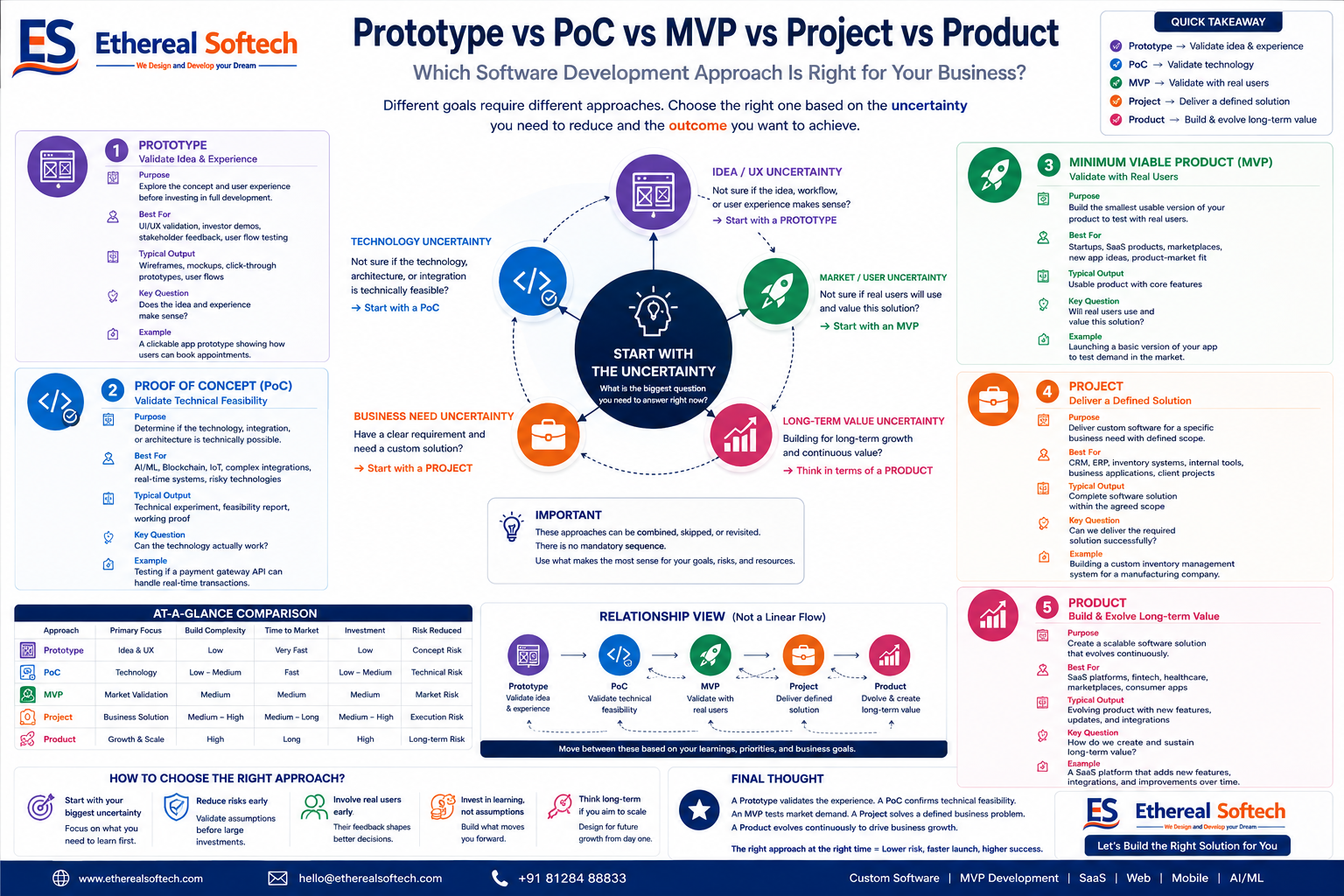
A Prototype helps validate the concept and user experience.
A PoC helps validate technical feasibility.
An MVP helps validate a product with real users.
A Project delivers a defined software solution.
A Product is built and continuously improved around users and business goals.
These are not mandatory stages that every software project must follow. Depending on the business, technical risk, product maturity, and objective, you may use one, several, or none of them.
Quick Comparison: Prototype vs PoC vs MVP vs Project vs Product
| Approach | Main Question | Primary Purpose | Typical Output |
|---|---|---|---|
| Prototype | Does the idea and user experience make sense? | Validate concept and UX | Wireframe, mockup, clickable prototype |
| PoC | Can the technology actually work? | Validate technical feasibility | Technical experiment or proof |
| MVP | Will real users use and value it? | Test the product with real users | Usable initial product |
| Project | Can we deliver the required business solution? | Solve a defined business need | Custom software solution |
| Product | How do we create value continuously? | Build and evolve a market solution | Continuously developed software |
The most important thing is not choosing the “best” option. It is choosing the option that addresses your biggest current uncertainty.
What Is a Prototype?
A software prototype is an early representation of a software idea used to explore its interface, user experience, workflows, or overall concept before investing in full development.
A prototype can be a simple wireframe, a high-fidelity design, or an interactive clickable model.
It does not necessarily contain production-ready code.
The main purpose is to answer questions such as:
- Does the user journey make sense?
- Is the interface easy to understand?
- Are we solving the right problem?
- Can stakeholders visualize the proposed solution?
- What should be changed before development begins?
When should you build a Prototype?
A prototype is particularly useful when the uncertainty is around the idea, interface, workflow, or user experience.
It can be useful for:
UI/UX validation, stakeholder reviews, investor demonstrations, user-flow testing, product planning, and early feedback.
Example
Imagine a startup wants to build a healthcare appointment platform.
The initial idea includes:
Doctor search, doctor profiles, appointment booking, payments, notifications, reviews, and an administration panel.
Instead of developing all of these features immediately, the team could create a clickable prototype showing:
Search doctor → View profile → Select appointment → Confirm booking
Stakeholders and potential users can interact with the flow and identify problems before significant development investment is made.
What a Prototype does not prove
A prototype can show how the solution could work from the user’s perspective, but it does not necessarily prove that the underlying technology is feasible.
An attractive prototype may still hide challenges involving APIs, security, performance, infrastructure, data processing, or integrations.
When the uncertainty is technical, a PoC may be more appropriate.
What Is a Proof of Concept (PoC)?
A Proof of Concept (PoC) is a technical experiment used to determine whether a particular technology, integration, architecture, or technical approach is feasible.
The primary question is:
Can we technically make this work?
A PoC is especially valuable when there is significant technical uncertainty.
For example, a development team might need to determine whether it can:
integrate with a difficult third-party API, process a particular type of data, establish real-time communication, connect legacy systems, support a hardware integration, or meet a specific performance requirement.
When should you build a PoC?
Consider a PoC when the biggest risk is technical feasibility rather than product design.
Common examples include:
AI/ML applications, blockchain systems, IoT solutions, real-time applications, complex payment integrations, legacy-system integrations, high-volume data processing, and unfamiliar technologies.
Example
Suppose a fintech company wants to build a platform that retrieves information from several banking systems.
Before building the complete platform, the team could develop a PoC to test:
Authentication → API connectivity → Data retrieval → Error handling → Response time
If the technical experiment succeeds, the business has stronger evidence that the proposed approach is feasible.
A PoC is not production software
This distinction is important.
PoC code is often created to learn, not to become the final architecture.
It may lack production-level security, scalability, monitoring, testing, documentation, error handling, and maintainability.
A successful PoC therefore reduces technical uncertainty; it does not automatically mean you have a production-ready product.
What Is a Minimum Viable Product (MVP)?
A Minimum Viable Product (MVP) is a usable version of a product containing the smallest set of capabilities needed to deliver meaningful value to its target users and learn from real-world usage.
The main question is:
Will real users use this solution and find value in it?
This is what separates an MVP from a prototype.
A prototype primarily helps validate the concept and experience.
An MVP puts a usable solution in front of real users.
When should you build an MVP?
An MVP is useful when:
the core problem is reasonably understood, the target users are identifiable, the team wants market feedback, and building the complete product upfront would create unnecessary risk or cost.
MVP development is common for:
SaaS products, marketplaces, mobile applications, startup products, new digital services, and new business models.
Example
Suppose a startup wants to create a food-delivery marketplace.
The long-term product might eventually include:
Customer applications, restaurant dashboards, delivery applications, live tracking, loyalty programs, subscriptions, promotions, analytics, and advanced recommendations.
The MVP might focus on:
Customer registration → Restaurant listing → Menu → Cart → Order → Payment → Basic order management
The startup can then release the product, observe actual usage, gather feedback, and decide what deserves further investment.
Minimum does not mean poor quality
One of the most common misunderstandings about MVPs is that “minimum” means low quality.
It doesn’t.
A good MVP minimizes unnecessary scope, not engineering quality.
The product should still be sufficiently reliable, usable, secure for its intended context, and maintainable for the stage at which it is being released.
What Is a Software Project?
A software project is a development initiative undertaken to deliver a defined solution or business capability.
A project normally has a specific objective, stakeholders, scope, resources, and delivery expectations, although the exact project-management model can vary.
The software may be created for internal use, for a specific organization, or for a particular client.
When is a Software Project the right approach?
A project approach is often appropriate when:
the business problem is understood, the required capabilities are reasonably clear, and the objective is to deliver a specific solution.
Examples include:
custom CRM systems, ERP systems, inventory management software, internal dashboards, workflow automation, business portals, employee management systems, and enterprise applications.
Example
A manufacturing company may need a custom inventory system.
The system could include:
Inventory tracking, purchase management, warehouse management, stock movements, user permissions, reporting, and integration with existing business systems.
The goal may simply be to solve that company’s operational problem.
It does not necessarily need to become a commercial product sold to thousands of customers.
That makes the nature of the work different from product development.
What Is a Software Product?
A software product is built around a user or market need and is intended to evolve over time through continuous development, feedback, maintenance, and improvement.
The question changes from:
Can we deliver the software?
to:
How do we continuously create value for users and the business?
A product has an ongoing lifecycle that may include:
Product discovery → development → release → user feedback → measurement → optimization → new capabilities
This does not mean every product follows the same process. The important difference is the long-term ownership and evolution of the software.
When should you think of software as a Product?
A product approach makes sense when you’re building software intended for:
SaaS customers, a broader market, multiple organizations, consumers, long-term customer relationships, or continuous commercial growth.
Examples include:
SaaS platforms, fintech products, healthcare platforms, marketplaces, B2B applications, consumer applications, and subscription software.
Example
A SaaS company may initially launch a scheduling platform with:
Appointment creation, calendar management, and basic notifications.
As customers use the platform, the roadmap may evolve to include:
Calendar integrations, payments, team scheduling, analytics, mobile applications, automation, enterprise controls, and third-party integrations.
The product continues changing because customer needs and business priorities change.
Prototype vs PoC: What’s the Difference?
The simplest distinction is:
Prototype validates the experience. PoC validates the technology.
A prototype may demonstrate how a banking application lets a customer transfer money.
A PoC may test whether the required banking API can securely support that transfer.
| Prototype | PoC |
|---|---|
| Focuses on concept and experience | Focuses on technical feasibility |
| Usually UX-oriented | Usually technology-oriented |
| Can be non-functional | Usually contains technical experimentation |
| Helps collect early feedback | Helps reduce technical uncertainty |
| May use design tools | Usually involves actual technical components |
Neither is universally better.
The correct choice depends on where the uncertainty exists.
Prototype vs MVP: What’s the Difference?
A prototype represents a potential solution.
An MVP is a usable solution released to real users.
Think of it this way:
Prototype:
“This is how the product could work.”
MVP:
“This is the smallest usable version we can put in front of customers to learn from real usage.”
A startup may therefore use a prototype before committing to MVP development.
However, not every MVP requires a separate prototype.
If the product is simple and the requirements are already well understood, a team may move directly into development.
PoC vs MVP: What’s the Difference?
A PoC answers:
Can we build this technically?
An MVP answers:
Can we create enough value for real users to justify continuing?
Consider a real-time video platform.
A PoC might test:
Can the architecture support real-time video communication?
An MVP might test:
Will our target users actually use this video solution for the intended business use case?
A technically successful PoC can provide useful evidence for MVP development, but a PoC is not automatically an MVP.
Project vs Product: What’s the Difference?
This distinction becomes particularly important when planning long-term software investment.
A project generally has a defined delivery objective.
A product has an ongoing lifecycle.
For example, a company might commission a custom HR management system to solve its internal requirements. Once the agreed solution has been delivered and accepted, that development project may be considered complete.
A SaaS HR platform, however, may continue evolving for years.
It could require:
new features, integrations, security improvements, performance optimization, analytics, pricing changes, customer support, and new product capabilities.
So, in simple terms:
Project = deliver a defined solution.
Product = continuously develop a solution around users and business goals.
A product can also contain many individual projects throughout its lifecycle.
Can a Project Become a Product?
Yes.
A business may initially build software as a project and later discover that the same problem exists across a wider market.
For example, a logistics company might build an internal platform to manage fleet operations.
After using it successfully, the company may discover that other logistics businesses have similar requirements.
The software could then evolve into a commercial SaaS product.
But this transition requires more than simply selling the existing application.
The architecture and business model may need to address:
Multi-tenancy, onboarding, billing, customer support, scalability, security, analytics, integrations, product analytics, release management, and long-term product strategy.
This is why deciding early whether software is intended as an internal project or a commercial product can influence architecture and technology choices.
Do You Always Need a Prototype, PoC, MVP, Project, and Product?
No.
These are not mandatory stages.
A common misconception is that every software idea should follow:
Prototype → PoC → MVP → Project → Product
That is not how real software development necessarily works.
The correct path depends on the business objective and the biggest risk.
Example 1: Simple internal business application
Defined requirements → Software Project → Production
There may be no reason to build a separate prototype or PoC.
Example 2: New SaaS startup
Prototype → MVP → Product
A PoC may not be necessary if the technology is already well understood.
Example 3: Technically complex platform
Prototype → PoC → MVP → Product
Here, both UX validation and technical feasibility may require separate validation.
Example 4: Established company with a clear business requirement
Planning → Software Project → Production
If the business requirements and technology are already well understood, additional validation stages may add little value.
The strategy should follow the risk, not a predetermined checklist.
How to Choose the Right Software Development Approach
Before starting development, identify the biggest question that still needs an answer.
Choose a Prototype if:
You need to validate the idea, interface, workflow, or user experience.
Choose a PoC if:
You need to validate technical feasibility, architecture, technology, or a difficult integration.
Choose an MVP if:
You need to validate real-world user demand and product value.
Choose a Project if:
You have a defined business requirement and need a custom software solution.
Choose a Product if:
You are building software intended to evolve continuously around customers, users, and business goals.
A Better Decision Framework
Instead of asking:
“Should we build a Prototype, PoC, or MVP?”
Ask:
What are we uncertain about?
If the uncertainty is user experience, start with a Prototype.
If the uncertainty is technical feasibility, consider a PoC.
If the uncertainty is market demand, consider an MVP.
If the business problem is already understood and the solution is defined, a software project may be sufficient.
If the goal is to create an evolving commercial solution, think beyond the initial project and plan for product development.
This simple shift in thinking can prevent businesses from spending heavily on the wrong thing too early.
What Happens After an MVP?
An MVP is not necessarily the end of development.
If the MVP demonstrates useful demand, the next phase may involve strengthening the product.
That could include:
Improving architecture, increasing scalability, strengthening security, improving performance, expanding functionality, adding integrations, improving analytics, optimizing user experience, and establishing a long-term product roadmap.
The exact priorities depend on what users actually need and what the business learns from the MVP.
The goal should not be to automatically add more features.
The goal should be to invest in the changes that create measurable user and business value.
Common Mistakes Businesses Make
Building the full product before validating the problem
A business can spend months building features before discovering that users don’t need them.
Early validation can reduce this risk.
Treating a prototype as production software
A clickable prototype may look complete, but appearance does not mean the underlying architecture, security, data model, or integrations are production-ready.
Treating a PoC as production code
PoC code is often created to test an idea quickly. Before using it in production, the architecture and implementation should be reviewed for security, reliability, scalability, and maintainability.
Calling everything an MVP
Not every first release is an MVP.
If the software is a complete custom internal system built to satisfy an established business requirement, it may simply be a software project.
Building features instead of validating assumptions
The purpose of early development should be to reduce meaningful uncertainty—not simply to increase the number of features.
Prototype vs PoC vs MVP vs Project vs Product: Final Decision
There is no universally correct software development approach.
The right choice depends on what you are trying to learn or accomplish.
Prototype — validate the concept and user experience.
PoC — validate technical feasibility.
MVP — validate the solution with real users.
Project — deliver a defined business solution.
Product — continuously create and improve value for users and the business.
In some cases, these approaches work together. In others, one may be enough.
The strongest development strategy is therefore not the one with the most stages. It is the one that reduces the most important risk before making the next major investment.
Frequently Asked Questions
What is the difference between a Prototype, PoC, and MVP?
A Prototype validates the concept, interface, or user experience. A PoC validates technical feasibility. An MVP is a usable version of a product released to real users to test demand and gather feedback.
Is a Prototype the same as an MVP?
No. A prototype is generally an early representation of a solution and may not be production-ready or fully functional. An MVP is a usable product designed to provide value to real users and generate learning from actual usage.
Is a PoC required before building an MVP?
No. A PoC is useful when there is significant technical uncertainty. If the technology and architecture are already well understood, a separate PoC may not be necessary.
Can a PoC become an MVP?
A PoC can provide technical learning or components that inform an MVP, but PoC code often requires additional engineering before it is suitable for production use.
What is the difference between a project and a product?
A software project generally focuses on delivering a defined solution or objective. A software product has an ongoing lifecycle and evolves based on user needs, business goals, feedback, and market conditions.
Can a software project become a product?
Yes. A custom software project can evolve into a commercial product if the business identifies a broader market opportunity and redesigns the solution, architecture, operations, and business model for long-term product use.
Which is better: Prototype or PoC?
Neither is inherently better. Choose a Prototype when the main uncertainty is around the concept or user experience. Choose a PoC when the main uncertainty is technical feasibility.
When should a startup build an MVP?
A startup should consider an MVP when it has a reasonably clear problem and target user and wants to test a usable solution with real users without investing in the complete product upfront.
Does an MVP need to be cheap?
Not necessarily. The goal of an MVP is to minimize unnecessary scope while delivering meaningful value. Cutting essential engineering quality simply to reduce cost can create technical debt and make learning from users more difficult.
What should I build first: a Prototype, PoC, or MVP?
Start with the biggest uncertainty. If you’re unsure about the user experience, consider a Prototype. If you’re unsure about technical feasibility, consider a PoC. If you’re ready to test the solution with real users, consider an MVP.
How Ethereal Softech Can Help
Choosing the right development approach before writing production code can save significant time, cost, and rework.
At Ethereal Softech, we work with startups and businesses across different stages of software development—from early idea validation and technical feasibility to MVP development, custom software, and long-term product engineering.
Depending on your situation, the right starting point may be a Prototype, PoC, MVP, custom software project, or full product development strategy.
If you’re unsure which approach fits your idea, talk to our software development team before committing your development budget.